
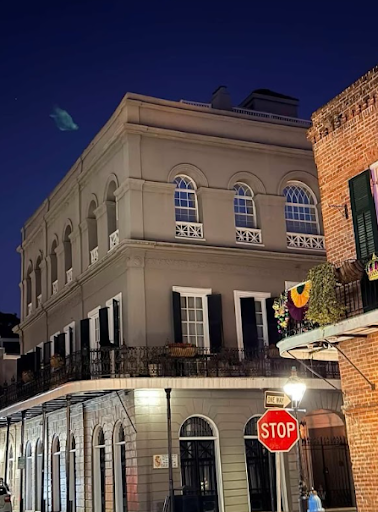
Maya woke at 2 a.m. and went to the kitchen for water. The house was quiet. Then she saw a tall, dark shape in the hallway. It had shoulders and a head. It seemed to turn toward her. Her skin went cold, and she froze. A car passed outside. Light slid across the wall, and the shape was gone.
Was it a ghost? Many people would say yes. A survey found that 58% of Americans agreed that places can be haunted by spirits. Scientists have studied moments like Maya's for decades. They have found no proof of spirits. But they have found many ways that the brain, the senses, and a room can create a ghost story.
Below are five popular types of ghosts and hauntings. Each section covers what people believe and what science says.
1. Residual Hauntings and the "Stone Tape" Theory
What People Believe
A residual haunting is described as an echo of a past event. The same footsteps, voice, or figure appear again and again. Believers say the event is stored in the walls, floors, or stone of a building. They say it plays back like a loop.
Where the Idea Comes From
The name "Stone Tape" comes from a TV play by Nigel Kneale. These ghosts are also called "recording" ghosts or "imprints." The ASSAP is a UK charity that studies unusual events scientifically and has published a critical look at the idea.
What Science Says
Nobody has shown how a building could record a person and play them back. ASSAP writer Maurice Townsend says no one has found a convincing physical mechanism or medium. ASSAP also states that the recording idea is not a scientific theory. It calls the idea speculation based on casual observation.
Five Problems With the Recording Idea
Townsend points out several weak spots:
Only the ghost appears. A video would show the whole scene. Most witnesses see just a figure. Full-scene cases, such as Edge Hill and Versailles, are rare.
Recordings never change. A tape plays the same way every time. Ghost sightings differ in small details from witness to witness.
Clothing changed with time. Ghosts have worn old-fashioned clothes only since the early 20th century. Before that, they wore the styles of their own day.
Names are often guesses. Many reports of Mary, Queen of Scots describe only a young woman where she once lived. The name was added later.
Famous cases grow from legend. A blurry shape on video at Belgrave Hall was called a "Victorian Lady." It was most likely an out-of-focus falling leaf.
Simpler Explanations
Townsend suggests the room may be doing the work. A stimulus in one spot can affect different people in similar ways. Car headlights moving across a wall at night are one example. A visitor who has never seen them may read the lights as a ghost.
Misperception can also build "hot spots." A poorly seen tree on a dark night can look like a person.
Charlton House in London shows the problem with recordings. Three investigators saw something at the same moment. Two saw a hooded monk. One saw only a vague darkness. A true recording would likely look the same to all three.
Could Infrasound Be the Cause?
A 2020 review in Frontiers in Psychology studied 66 papers on environmental factors in haunts. Infrasound is one of six factors it covers. Infrasound is sound below about 20 Hz. It is a hum too low to hear. Wind, machinery, aircraft, and air moving through ducts can all produce it.
Here is what the review reports:
The 19 Hz idea: In 1998, Vic Tandy and Tony Lawrence proposed that infrasound near 19 Hz could vibrate the eyeball. They said this might cause ghostly sights.
A later test failed to back it: Simon Parsons measured the same Coventry cellar in 2006. He found a broad range of frequencies, with a peak at 5.7 Hz.
Critics found gaps: Tandy's measurements lacked key details. Weak infrasound also has not been shown to affect the body.
Field studies point elsewhere: Parsons and others found high infrasound at several frequencies at UK haunts. It seemed to add to witness reports. It did not support the 19 Hz eyeball idea.
Concerts gave unclear results: Shows with added infrasound drew reports of unease, tingling, and a sense of presence. Researchers could not tell whether the sound, the setting, or the suggestion caused it.
Infrasound has been proposed as one possible contributor. The evidence is mixed. It is not an established cause of shadowy visual illusions.
2. Intelligent or Interactive Spirits
What People Believe
This ghost seems aware of you. It answers questions, taps back, or whispers a name. People say it keeps its personality and its feelings.
What Science Says
There is no scientific evidence that interactive spirits communicate with the living. Expectation, suggestion, and pareidolia can make unclear sounds or images seem meaningful.
What Is Pareidolia?
Pareidolia is seeing or hearing meaning in random patterns. Faces in clouds are the classic case. Science News Explores explains how it works. The brain gets a jumble of signals from the eyes, ears, and skin and it turns them into a clear picture. It also fills gaps using what it expects.
Psychologist David Smailes says most of what we perceive is the brain filling in gaps. You have likely misheard a song lyric. After you learn the "right" words, you keep hearing them. Ghost-hunting recordings work the same way.
Voices in the Static
Ghost hunters call these recordings electronic voice phenomena, or EVP. A 2022 PLOS ONE study from Swansea University tested how expectation changes what people hear.
The setup: Sixty-one people listened to clips of claimed ghost voices, muffled speech, clear speech, and white noise. One group was told the study was about ghost voices. The other group was told it was about voices in noisy places.
The expectation effect: The ghost-primed group heard more voices in the ghost clips than in the muffled speech. The other group showed no such gap.
A partial result: The primed group did not hear more voices overall. The authors call it a partial replication of an earlier study.
Almost no agreement: Only 9 of 984 scorable guesses (0.91%) matched what the TV ghost hunters said the clips contained.
Earlier work points the same way. In one study, 36% of people reported hearing voices in random noise after watching videos about EVP. The PLOS authors cite this finding.
Faces in the Dark
Pareidolia works for faces too. A 2023 study in Scientific Reports explains why. Faces are the most important sights in social life. Our visual system is tuned to spot them. Brain scans show that illusory faces trigger much of the same network as real faces. This happens within about 200 milliseconds.
The researchers gave 75 healthy adults gentle 40 Hz brain stimulation over face-related areas. Afterward, those adults mistook scrambled images for faces about 10% more often than the sham group. This was a lab test, not a ghost test. It shows that face illusions come from normal brain activity.
Smailes ran a 2018 study with 82 volunteers. People who reported more hallucination-like experiences also saw more faces in flashes of noise. He notes that people who sense ghosts are often alone, in the dark, and scared. With little visual input, the brain adds more of its own.
Who Notices More?
Personality plays a part here. The PLOS study found that highly sensitive people report more paranormal experiences. The authors suggest traits such as openness might explain the link. They call this idea speculation.
3. Poltergeists ("Noisy Ghosts")
What People Believe
A poltergeist is said to be an active, disruptive force. It slams doors, moves objects, makes knocks and raps, and disrupts electronics. Many cases center on one person.
What Science Says
No reliable scientific evidence has established psychokinesis as the cause of poltergeist activity. Researchers instead look at sound, structure, hidden hazards, and the mind.
Poltergeists and Haunts Overlap
The Frontiers review notes that the line between poltergeists and haunts is thin. Their features overlap. Both share a set of experiences that follow one pattern. That hints at shared causes.
Everyday Causes Researchers Have Examined
Sound and vibration: Physics papers by R. Vinokur (2005 and 2016) show that natural low-frequency sound can rattle windows. It can also create whispering effects.
Ground movement: Pressure on rock along fault zones can produce electricity. Seismic activity can also change local magnetic fields.
Magnetic fields: Michael Persinger's lab work suggested that complex weak magnetic fields can trigger a sensed presence. Braithwaite found such patterns at only 2 of about 50 haunt sites. A study that tried to replicate the effect pointed to the suggestion instead.
Odd events and EMF spikes: In two studies by Brian Laythe, recorded strange events lined up with short EMF spikes. One included object movement at a purported haunt. The review says these results need independent checking.
Hidden hazards: A 1921 case described a couple with headaches, phantom footsteps, and seen figures. A faulty furnace was leaking carbon monoxide. A 2009 case involved a badly fitted gas water heater. The review notes that such cases are rare.
Fraud: Some cases are explained as hoaxes. The review lists fraud alongside gullibility and imagination.
Stress and the Mind
Researchers also study the people at the center of these cases. The review cites work on psychogenic illness and on a psychological "dis-ease" model of poltergeist agents. These ideas link stress and bodily symptoms to such episodes, but they are under study.
The Haunt Project
In 2009, researchers built a "haunted" room to test these ideas. It was empty, white, and circular. They varied two things: electromagnetic fields and infrasound. Participants wandered the room for nearly an hour and noted their impressions. They knew in advance that they might feel odd sensations.
People reported many unusual perceptions. Those reports did not match the real conditions in the room. The team credited expectation and suggestion. The review adds two cautions. The room was dim and cool, which fits haunted settings. Critics also said the infrasound setup lacked detail and ambient measurements.
Suggestion in the Séance Room
Richard Wiseman and colleagues staged fake séances. They told people an object was moving when it was not. Later, 31% of participants wrongly recalled movement. The PLOS paper reports this result. False recall was linked to belief in the paranormal.
Six Environmental Factors, Tested
Factor
The idea
What studies found
Embedded cues
Paintings and mirrors create a sense of presence
A mansion study and a house study found no significant effects. Mirrors trended the opposite way
Lighting
Dark rooms raise expectation
Mixed. One house study found no difference. A Scottish vaults study linked light levels outside test areas to reports
Air quality
Mold or gas causes odd sensations
Mold is untested for haunts. Carbon monoxide explains a few rare cases
Temperature
Cold spots mark a ghost
A haunted house was colder than a control house. Rooms inside it showed no link to reports
Infrasound
Hidden low sound causes unease
Mixed. Some field links, but the 19 Hz idea is weak
Electromagnetic fields
Fields trigger hallucinations
Mixed. Some links to field changes, others none. Measuring is hard
The review found mostly null, inconsistent, or weak results. It concludes that an environment-only model is not enough to explain haunted houses.
4. Shadow People and Apparitions
What People Believe
Shadow people are dark, human-shaped figures. They appear at the edge of vision or at the foot of the bed. Apparitions are fuller figures. Many witnesses also feel that someone else is in the room.
What Science Says
Shadow figures can have several non-paranormal explanations. Sleep paralysis can produce vivid figures, sounds, and a sense of presence. Other hallucinations and perception errors can create similar experiences.
Sleep Paralysis
Science News Explores tells the story of a man named Dom. At 15, he woke to see a faceless, skeletal figure rush through his door. He had known sleep paralysis since he was eight or nine. He would wake unable to move.
The cause lies in REM sleep. In this stage, vivid dreams happen. The body is paralyzed to stop you from acting them out. The brain normally switches the paralysis off before you wake. In sleep paralysis, you wake while it is still on. You cannot move, speak, or breathe deeply. You may see, hear, or feel figures that are not there.
Neuroscientist Baland Jalal compares it to dreaming with your eyes open. Dom now focuses on his breathing and relaxes until the episode passes.
Hallucinations in Healthy People
Smailes says just about everyone has brief hallucinations. Examples include a phone buzz with no message, or a voice calling your name. Most people ignore them, but some turn to ghosts as the answer. Trusting your senses feels easier than believing your brain made a mistake.
When the Brain Misses Things
The brain can also miss what is really there. This is called inattentional blindness. In the famous gorilla video, about half of the viewers miss the gorilla. Psychologist Christopher French found that people who get absorbed easily also report stronger ghost beliefs. They tend to have lower working memory, too.
A window may seem to open on its own. Someone may have opened it while you were focused on something else.
Dark Rooms and Mirrors
The Frontiers review adds more on the setting:
Sensory deprivation: In one experiment, people sat in a chamber with no sound or light. Both low and high scorers reported more psychotic-like experiences. Suggestibility and fantasy proneness did not explain it.
Mirror and eye gazing: Giovanni Caputo found that healthy people see strange effects when they stare into a mirror, a dark space, or a face. This happens in low light. The effects fall into three groups: feeling out of body, distorted perception, and a strange face replacing your own.
Lighting: At the South Bridge Vaults in Edinburgh, light levels outside test areas were linked to anomaly reports. The review says darkness itself may be the real driver.
How Common Are These Experiences?
In the PLOS study, 57% of participants had at least one earlier paranormal experience. The most common was sensing a figure nearby when no one was there. About one in three (20 of 61) said they believed they had seen an apparition or ghost.
Shadow Figures in Photos
Photo experts have a checklist for shadow figures. If no flash fired, a long exposure is the likely cause. If other people were nearby, a living person may have crossed the shot. If the figure is against a wall, it may be a shadow cast by someone in the scene.
5. Orbs and Ectoplasm (Vapor or Light Anomalies)
What People Believe
Orbs are glowing spheres in photos. Ectoplasm and ectomists are pale vapors said to show a spirit forming. Believers read both as signs of a soul in transition.
What Science Says
Photo analysis gives some of the clearest answers to all five types. Ordinary light, dust, moisture, smoke, and camera effects explain these images well. Science has not explained every ghost photo ever taken. It has only found ordinary causes for the common ones.
Why Orbs Appear
A Skeptical Inquirer guide by Kenny Biddle and Joe Nickell explains the cause. A camera flash bounces off specks near the lens. These can be dust, water droplets, or flakes of snow. They are out of focus, so they show up as round, glowing discs. This effect was well understood by the 1980s. It can be recreated on purpose.
Other photo intruders create similar images:
A camera wrist strap can make a bright, white strand. A braided strap can look like a swirl of "spirit energy."
Hair, jewelry, insects, and fingers can also drift into the frame.
Slow shutter speeds turn points of light into glowing lines when the camera moves.
Phone "ghost apps" and photo editing can add fake figures.
What Is Ectoplasm?
Ectoplasm is an imagined spirit substance. The guide says "ectoplasmic" mist usually turns out to be flash-lit cigarette smoke, frosty breath, or fog.
One 1968 example comes from Mackenzie House in Toronto. A ghost hunter photographed a "mysterious mist" over a man's hands at a piano. White sheet music had bounced her flash and washed out part of the picture.
A Short History of Fake Spirits
Early cameras did not capture ghosts. That changed around 1859 with glass-plate negatives, which made double images easy. Boston photographer William Mumler found faint extra faces on reused plates. He then sold himself as a spirit photographer. Mary Todd Lincoln was among his clients. He was exposed when some of his "spirits" were recognized as living Bostonians.
A 1921 count listed 22 ways to fake spirit photos. The famous 1936 "Brown Lady" photo from Raynham Hall was also later shown to be a fake. It was made by layering one image over another.
The Burden of Proof
The authors make a firm point. Calling a photo paranormal because it is unexplained is an argument from ignorance. The person making the claim must prove it. The review adds that some odd light readings from séances require more study.
Keep the Chills, Question the Ghost
Science has not proven that ghosts exist. It has shown why the chill feels so real. Dark rooms, tired brains, and clever camera tricks can all shape a sighting.
Hottest Hell Tours runs walking tours through New Orleans' haunted history, true crime, and Voodoo traditions. We tell these stories with care for the real people in them. We do not claim to prove ghosts. We also do not claim science has explained every tale. Come for the legends, and bring your curiosity.
Frequently Asked Questions
Has there been any scientific proof of ghosts?
No. Scientists have found no reliable proof that ghosts exist. Photos and recordings have had ordinary explanations. Research does show how sleep paralysis, pareidolia, and expectation create real ghostly experiences. The feeling is real, but the spirit itself remains unproven.What is a famous female ghost in folklore?
La Llorona, the Weeping Woman, is among the best-known female ghosts in folklore. Mexican and wider Latin American tales say she wails by water, searching for her drowned children. Another famous example is the Brown Lady of Raynham Hall, England.Can infrasound make a place feel haunted?
It might play a small role, but the evidence is mixed. Some UK field studies linked high infrasound to witness reports. An experiment called the Haunt Project found no link. According to researchers, infrasound alone cannot explain haunted places or sightings.