
“All of us are standing on someone else’s shoulders. Someone else that opened the door and paved the way. And so, we have to understand that we cannot give up the fight, whether we see the fruits of our labor or not. You have a responsibility to open the door to keep this moving forward.”
Ruby Bridges, The Guardian, 2021
This blog explores Ruby’s life and actions. By the end, you’ll gain an admiration for why she still matters today.
Who Was Ruby Bridges?
Ruby Bridges was born on Sep 8, 1954. Her parents were Lucille and Abon Bridges. Abon was a veteran of the Korean War. He was a mechanic. Lucille, her mother, did domestic work.
Pretty early in her life, Ruby’s parents moved to New Orleans. Their move overlapped with a critical moment in U.S. education. In 1954, the supreme court issued the key decision in Brown v. Board of Education of Topeka, Kansas. It declared that racial segregation in public schools was against law.
This decision demanded every school to desegregate. They should now provide Black students with the chance to attend all-white schools. But black children had to prove their eligibility for this. A test was created and only those who passed it could attend schools of the white.
Ruby passed the exams. Ruby’s father hesitated in sending her off to school. But her mother wanted Ruby to get a good education. So, regardless of the trials that lay ahead, Ruby began her journey of pursuing education. She became a trailblazer. At 6, she was the first African-American in the South to attend an academic institution for the whites.
A Moment That Changed History
Many things that will seem shocking to us today occurred on Nov, 14, 1960. Many things that feel unimaginable today took place on November 14, 1960, the day Ruby Bridges first walked into school. What she faced was not just “discrimination,” but open, violent racism. Crowds gathered to scream insults at a six-year-old child as she entered the building under federal protection. She was the only Black student in her class, completely isolated in an environment filled with hostility.
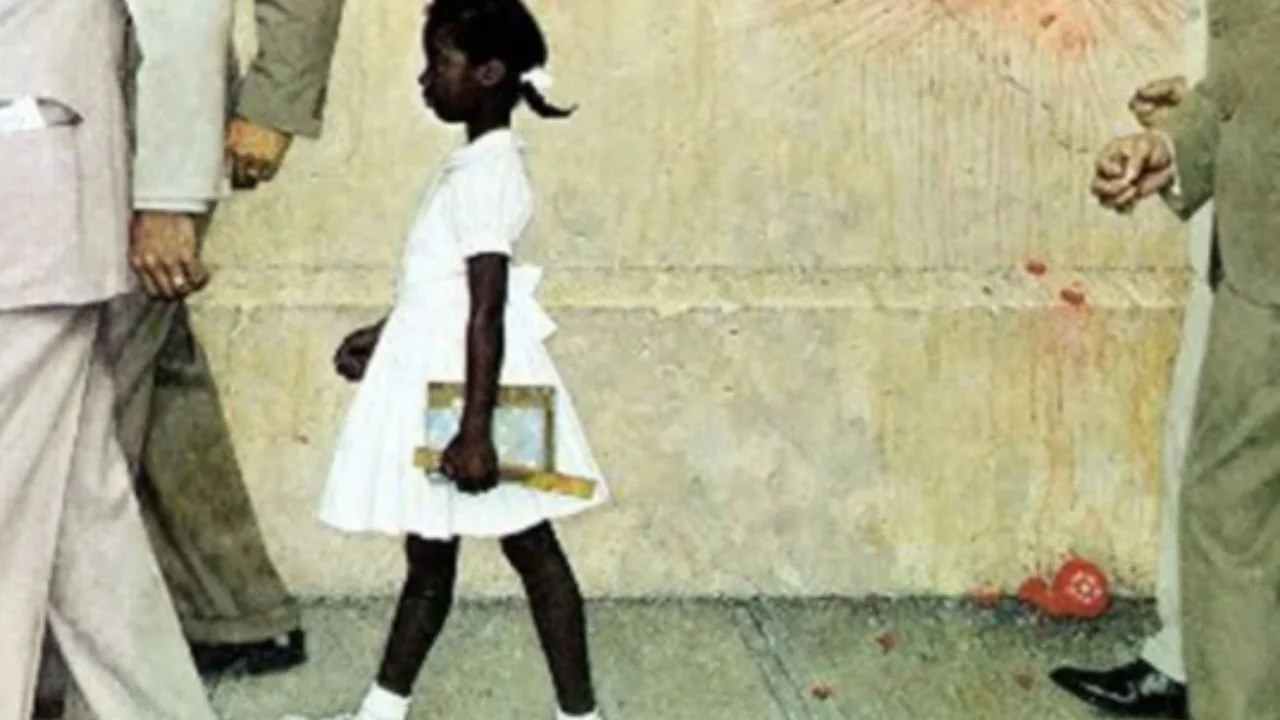
Even images that later came to symbolize her courage, like Norman Rockwell’s famous painting, leave out some of the harshest realities, such as the racial slur spray-painted on the wall as she walked by. It’s difficult to comprehend the weight of that moment on someone so young.
And yet, despite all of this, Ruby showed extraordinary resilience. She continued to attend school every day, never missing a single day, even in the face of relentless hatred.
Her teacher was Barbary Henry. She was a white woman from Boston. Only Henry supported Ruby’s education. She was her only teacher for the full first grade.
Many decades later, Bridges showed her respect for Henry. She said, “Even though she looked exactly like people outside the school, she showed me her heart.”
The racism Ruby faced daily took the following forms:
Many white children’s parents opted to homeschool them.
Objects were thrown at her.
She was ‘greeted’ by a woman displaying a black doll. The doll was in a wooden coffin.
Someone had painted the N-word on the wall she had to walk past.
Ruby could not use public spaces like the cafeteria.
A U.S. Marshall accompanied her everywhere at school, even when she wanted to use the bathroom.
How Ruby’s Family Was Affected
Ruby was not alone in this struggle. Her parents, Abon and Lucille Bridges, supported her every step. But their choice came at a cost.
Bridge’s presence in the school was met with disdain. This led Lucille to lose her Job. Abon also lost his job. The NAACP encouraged him to not look for work. Doing so would put him in more danger. All this created tension at home.
Bridge’s grandparents didn’t live with her. But even they were negatively affected in Mississippi. In Bridge’s own words, “I’m the oldest of eight, and at that point he was no longer able to provide for his family. So they were solely dependent on donations and people that would help them”
After some time, Ruby’s parents split. Caused bythe hostile circumstances they were forced to live under. Small Bridges faced enormous problems at a young age. This didn’t escape the notice of Robert Coles. A child psychologist, he volunteered his services to her. Coles was white. Still, he wanted to support Ruby and her parents. Multiple days in a week, he visited their home. His efforts caused him to excel in his career. He became a leading figure on how desegregation affected young children.
Ruby Bridges in American Culture
Ruby’s first day at William Frantz Elementary is captured in art and books. The famous painting The Problem We All Live With by Norman Rockwell shows her courageous walk. This image became one of the most recognized memorials of school integration.
Her experience has been shared with new generations through many forms:
A Disney film based on her life story (1998).
A children’s book she co‑authored with psychologist Robert Coles.
Statues and markers at her old school on the Louisiana Civil Rights Trail.
Ruby Bridges became not just a local story but a national icon for civil rights. Her life shows how one small person can make a big difference.
The Ruby Bridges Foundation
Ruby did not stop speaking about justice after her school years. In 1999, she established the Ruby Bridges Foundation. The foundation’s goal is to promote tolerance and respect through education.
Ruby often says that “racism is a grown‑up disease.” She hopes children can learn early that differences make us stronger.
The foundation works with schools and communities to teach kindness. It encourages young people to learn from history, not hide from it.
What Ruby Bridges Teaches Us Today
Ruby’s story remains important because it speaks to courage in the face of hatred. Her example teaches several lessons that still matter:
Courage can start small. A child can show the world how to be braver.
Education matters. Every child deserves a fair chance to learn.
Change takes sacrifice. Progress is rarely comfortable.
History helps us learn. Knowing the past builds a better future.
Ruby’s legacy is not just about one school or one city. Her courage helped the nation move toward equality. Her story inspires people of all ages around the world.
Ruby Bridges History in Context
To understand her legacy fully, it helps to consider the larger civil rights movement. Before Ruby’s day in 1960, schools had long been segregated across the South. The Supreme Court’s Brown v. Board of Education decision in 1954 said segregation was unconstitutional. Yet many local leaders resisted the ruling for years.
Ruby’s walk into school was a breaking point. It forced America to confront a reality it had long ignored. The image of her walking with marshals through hostile crowds made that moment unforgettable.
How Ruby Bridges’ Story Is Remembered
Today, Ruby Bridges continues to share her message. She speaks in schools and public forums to encourage learning and unity. Her foundation helps spread her philosophy of tolerance and respect. The school she integrated is now part of the Louisiana Civil Rights Trail.
Every year, communities remember her first walk into William Frantz Elementary School. Anniversaries are marked with celebrations and educational events. These moments remind us that history is not distant. It continues to shape how we live and learn today.
Why Ruby Bridges' History Still Matters
Ruby Bridges' history shows the power of courage and conviction. Her experience changed how America was allowed to think about education and equality. Many children today go to schools that are more diverse because of her walk. Her story reminds us all that fairness and justice must be defended.
Understanding her legacy helps us teach younger generations about empathy. It encourages people to stand for what is right. Every time someone learns her story, they carry her message forward.
Walking in the Footsteps of Change
At Hottest Hell Tours, we aim to bring history to life. We believe stories like Ruby Bridges' history matter deeply. Even though we focus on dark history and New Orleans culture, we respect all stories that define our past.
Our tours are led by historians who value truth and context. We tell stories that teach, pose questions, and inspire reflection. Guests learn about real history without myths or exaggeration.
We explore how places like New Orleans shape memory and identity.
Just as Ruby Bridges’ walk changed schools, historical tours can change how people see a city. Walking through history helps connect facts with feeling and meaning.
At Hottest Hell Tours, you won’t just hear history. You will feel it.