
Louisiana is unlike any other state in America. Its folklore proves that plainly. No single culture built it. Dozens did. French colonists, Spanish governors, West African enslaved people, Acadian exiles, Canary Island settlers, and Native nations all contributed. Each group brought a storytelling tradition from somewhere else. Those traditions collided in the bayous, the French Quarter, and the cane fields. What came out was singular. Louisiana's folklore is not decoration. It is documentation. It tells you who suffered here and who survived. Most importantly, it tells you how people made sense of a world that they lived in.
Why Louisiana Folklore Is Different
Folklore scholars often describe Louisiana as one of the most culturally layered states in the country. Its oral traditions reflect that layering directly. Stories travel across linguistic lines. A French werewolf legend bleeds into a Houma Nation spirit tale. A West African trickster figure reappears in a Cajun household. A Canary Island song form adapts to describe life in the Louisiana marshes. Each overlap tells you something real. These were not separate communities developing separate stories in sealed rooms. They were neighbors, sometimes unwillingly, sometimes not. Their stories touched each other constantly.
Folklorists often divide Louisiana into broad cultural regions. North Louisiana reflects primarily British-American and African American storytelling traditions. South Louisiana, known as Acadiana, carries deep French, Creole, and Indigenous influence. New Orleans developed its own dense urban mythology. The southeastern parishes hold Spanish-speaking Isleño communities. Each region has a distinct voice. Yet the same fears, the same swamp, and the same uncertain sky appear across all of them.
Native Voices: The First Stories
The Chitimacha, Choctaw, and Houma nations each maintained rich oral traditions long before European contact. Many of their stories explain natural phenomena. Early scholars sometimes labeled these as "folktales," which misrepresents them. A creation story is not casual entertainment. It is cosmology. It is law.
The Houma oral tradition is particularly worth noting here. It developed in southeast Louisiana, in close contact with French Acadian communities over many generations. Two creatures appear in both Houma and French Acadian tradition. These are the rougarou and the lutin. The rougarou comes from the French term loup-garou. The lutin is a mischievous figure, roughly equivalent to an elf. In French, the lutin braids horses' manes at night. In Choctaw tradition, a closely related figure called the bohpoli does almost the same thing. That similarity reflects centuries of cultural contact between communities who shared the same landscape.
The Houma Nation also preserves the memory of Rosalie Courteaux. She was described as the last great leader of the Houmas and died in 1885. Very little written documentation of her life survives. Her legacy lives primarily through oral retellings of her defense of her people. That is itself a statement about how power controls the archive.
The Rougarou: A Curse That Traveled
Few figures in Louisiana folklore are as widely recognized as the rougarou. The word comes directly from the French loup-garou, meaning werewolf. But Louisiana's version is distinctly its own. Scholars note that storytellers rarely describe it as a wolf at all. It appears instead as something like a dog, a large bird, or a distorted human shape.
The rougarou spreads through a curse. In the most common version, the creature can only break its own curse by drawing blood from another person. That person then carries the curse for 101 days. The catch is silence. Anyone who encounters a rougarou and reveals it before a year and a day passes becomes the next rougarou. The secrecy is built directly into the legend's structure.
The social function of the rougarou is clear. It policed behavior. In many Cajun versions, it targets Catholics who break the rules of Lent. In others, it hunts disobedient children. One protective tradition holds that placing 13 small objects near your front door will confuse and deter it. The rougarou, supposedly, cannot count past 12.
Today the legend lives on in a tangible way. The annual Rougarou Fest takes place in Houma every October. It celebrates both the creature and the broader Cajun heritage it represents. That a fictional monster now anchors a regional cultural festival tells you something important. These stories were never really about monsters.
Feu Follet: The Fool's Fire
The feu follet is one of Louisiana's most genuinely documented phenomena. The name translates from French as "fire of the fool." The lights are real. They appear deep in the bayous, hovering above the water or drifting through the trees.
The scientific explanation is well established. Methane gas and other organic compounds escape from decaying plant matter in swamps. Under certain conditions, they ignite spontaneously. The result is a floating orb of pale light with no obvious source and no fixed path.
Louisiana folklore layered meaning onto that light immediately. In the French and Creole tradition, feux follets are the souls of unbaptized infants. They are caught in spiritual limbo between this world and the next. Unable to enter heaven without the sacrament of baptism, they wander the swamps restlessly. Their behavior reflects their nature. They are childlike and mischievous. They lead travelers off paths and into marshes. Some tellings describe victims becoming hopelessly lost while following a feu follet. Others say those victims never found their way back at all.
The deeper meaning here is not hard to find. Catholic doctrine on unbaptized infants was a genuine source of grief and theological anxiety for generations of Louisiana families. The feu follet gave that grief a shape. It also gave the swamp its reputation as a place where the unresolved dead still wander.
Pere Malfait: The Cajun Boogeyman
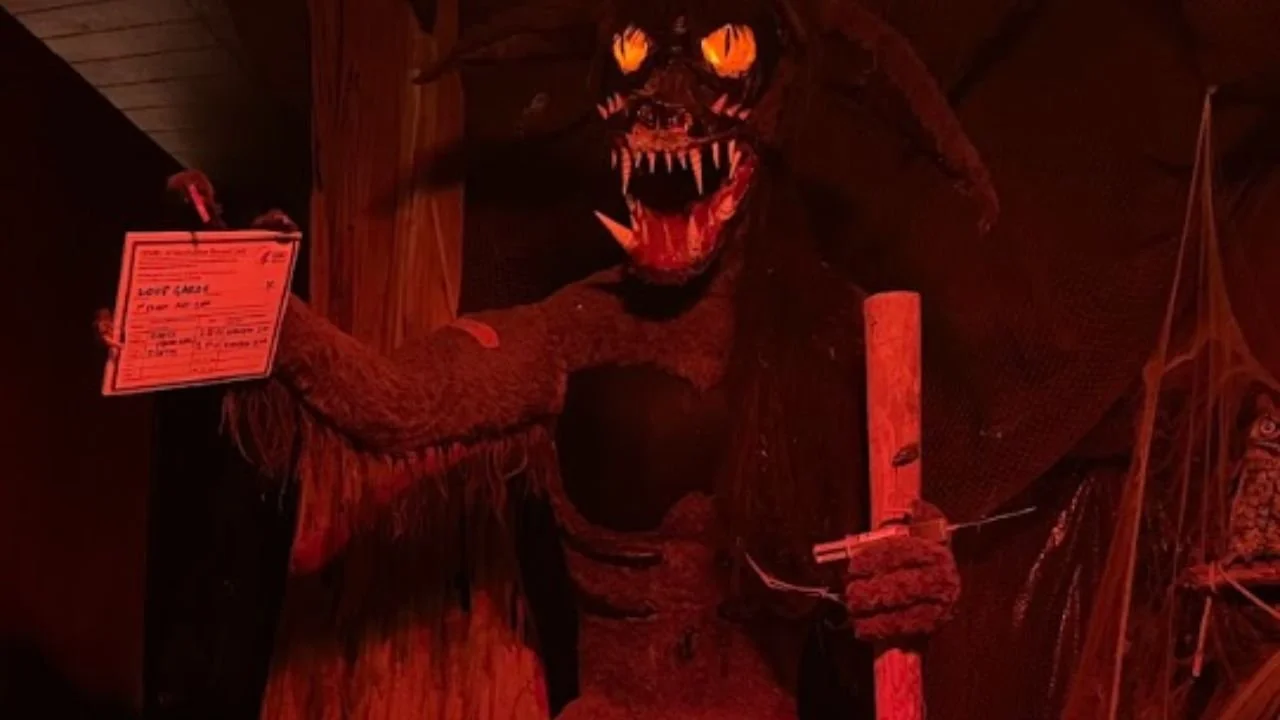
Every culture produces a figure designed to frighten children into compliance. Louisiana's version goes by the name Pere Malfait. He is the Cajun equivalent of the boogeyman. His physical description is consistent across tellings. He is enormous. His eyes glow. His body is draped in the Spanish moss that hangs from cypress trees throughout the bayou. He has superhuman strength and is said to crush his victims.
Unlike many folklore creatures, Pere Malfait has a known weakness in tradition. A stake made specifically from swamp gum tree wood is said to be his only vulnerability. That detail is precise in a way that feels intentional. It ties the creature to the specific ecology of Louisiana. The weapon that defeats him comes from the same landscape he inhabits.
Pere Malfait is ultimately a parenting tool wrapped in horror. The bayous were genuinely dangerous, especially for children who wandered too far from home. A creature made of the swamp itself, watching for disobedience, was a memorable way to keep children close.
Bouki and Lapin: The Trickster Tradition
Among the most intellectually significant figures in Louisiana folklore are Bouki and Lapin. These two characters appear throughout the French- and Creole-speaking parts of the state. Lapin is the hare, a classic trickster in the French tradition. Bouki is his frequent foil. The name Bouki is the Wolof word for hyena, and scholars have confirmed that West African and Caribbean influences shape this tradition directly.
These stories were documented as early as 1895. Alcee Fortier, a Louisiana linguist and historian, collected many of them from Black Creole storytellers in New Orleans and in St. James Parish. His collection, published as Louisiana Folk-Tales, preserves stories that blend French and West African narrative structures into something uniquely Louisianan. The tales feature clever small figures outwitting powerful ones. That was not accidental. These stories were told by people who survived slavery. Cleverness was survival. The trickster who wins against the stronger opponent was not merely entertaining. It was aspirational.
Historians including Gwendolyn Midlo Hall have shown that Senegambian people, particularly those from Wolof and Bambara communities, made up a large portion of Louisiana's enslaved population during the colonial period. The presence of Wolof vocabulary in Louisianan folklore is direct evidence of that history.
Jean Sotte: The Fool Who Teaches
Jean Sotte is another enduring character in Louisiana's French and Creole folklore. His name means, roughly, John the Fool. He is a version of Jean-le-Sot, a figure found across the French-speaking world. In Louisiana, he is the bumbling, too-literal son who always misunderstands his mother's instructions.
A classic episode illustrates the point perfectly. Jean's mother asks him to milk the cow, using the Louisiana French verb tirer. But tirer also means to shoot. Jean shoots the family cow. His mother is horrified. He understood the words but not the world.
These tales function on wordplay and homonyms. They are nearly impossible to translate into English without losing the joke entirely. They exist fully in French. They were a way for French-speaking Louisianans to tell stories that could not be translated by the English-speaking world around them.
Madame Grands-Doigts, La Christine, and the Holiday Tradition
Louisiana folklore produced two intriguing figures tied to the Christmas and New Year holidays. The first is Madame Grands-Doigts, meaning Lady Long Fingers. She is one of the more ambivalent characters in the tradition. Different families describe her differently, even within the same small region. Some families know her as a frightening punisher of disobedient children. Others describe her as a gentle figure who brings fruit and small gifts on New Year's Eve.
That ambivalence is unusual in folklore. Most cautionary figures are reliably terrifying. Madame Grands-Doigts can be either, depending on whose family you ask. That flexibility suggests a figure who adapted to individual household needs and values over generations.
La Christine is a fascinating example of German influence inside Cajun culture. She derives from the German das Christkind, the Christ-child figure still common in Germany today. In francophone Louisiana, the term was Gallicized. The gender shifted. La Christine became a magical female figure, sometimes described as the wife of Pere Noel, who brings children small gifts and fruit during the New Year holiday. German immigrants to Louisiana shaped this tradition, and it was absorbed completely into Cajun French culture.
Kooshma: The Spirit of Sleep
Kooshma, also known as cauchemar (the French word for nightmare), is a malevolent spirit most widely known among Louisiana Creoles of color. She is typically described as female. She sits on a sleeping person's chest, pinning them down and filling them with dread. The victim is aware but cannot move or speak.
Modern medicine recognizes this experience as sleep paralysis, a well-documented neurological phenomenon. But Louisiana's folk tradition gave it spiritual meaning long before that clinical explanation existed. In the Creole understanding, kooshma is often a punishment for sins. She arrives when a person has done something wrong. Specific prayers and certain religious objects are said to drive her away.
This overlap between Catholicism and folk belief is characteristic of Louisiana's religious landscape. The two never fully separated here. Prayers and spiritual protection objects occupied the same space in daily life for many Creole families across generations.
The Honey Island Swamp Monster
Louisiana's answer to Bigfoot lives in the Honey Island Swamp, roughly thirty miles northeast of New Orleans. The creature is described consistently across accounts. Its fur is gray and thick. Its eyes are red and reptilian. Its feet are webbed. It is large enough to leave substantial tracks through the mud.
The first reported sightings came in the early 1960s. Like most cryptid accounts, the witnesses lacked photographic evidence. The creature was never captured or conclusively documented. The origin story attached to the Honey Island monster, which involves escaped circus animals interbreeding with local wildlife, has no scientific basis. Biologists have confirmed that the species combinations suggested are not reproductively possible.
What the Honey Island Swamp Monster does document is the real strangeness of the swamp itself. The Honey Island Swamp is one of the least-developed wetlands in the country. Its interior is genuinely remote. People who go in without a guide do sometimes fail to come back out. A creature story attached to a dangerous landscape serves a recognizable purpose. It makes the danger personal and therefore memorable.
The Grunch: New Orleans' Urban Legend
The Grunch is one of New Orleans' most distinctive urban legends. Unlike the swamp-based creatures above, the Grunch belongs to the road. Specifically, it is tied to a stretch outside the city called Grunch Road. The creature's description varies considerably across tellings. Some describe a scaly, horned humanoid with glowing eyes. Others describe a group of pale, isolated figures living in the bayou margins.
The legend includes a specific warning. If you are driving near Grunch Road and you see a goat stranded on the shoulder, do not stop. The stranded goat is said to be bait. The Grunch is reportedly nearby.
The Grunch draws on several existing traditions at once. Scholars note elements borrowed from Chupacabra stories, the Rougarou, and other regional legends. It is a hybrid creature, assembled from pieces of older fears and fitted to a specific local geography. That kind of bricolage is entirely normal in urban legend formation.
Evangeline: History as Folklore
Not all Louisiana folklore is supernatural. The story of Evangeline is rooted in a real historical event. In the 1750s, British colonial authorities expelled the Acadian people from their homeland in Nova Scotia, in what is now Canada. That forced displacement is called Le Grand Derangement. Thousands of Acadians were scattered across the Atlantic world. Many eventually found their way to Louisiana, where they became the people known today as Cajuns.
In 1847, American poet Henry Wadsworth Longfellow published an epic poem called Evangeline. The poem follows a young Acadian woman separated from her fiance during the expulsion. She spends years searching for him across a displaced and grief-stricken world. She finds him, finally, as he is dying.
Evangeline became the emotional symbol of an entire people's loss. Acadians adopted her. Statues of Evangeline were erected in Louisiana. The town of St. Martinville claims a connection to the poem's setting. Whether those specific local details are historically verifiable is debated. What is not debated is the poem's cultural weight. It turned collective displacement into a story individual people could carry. That is what good folklore does.
Julia Brown and the Hurricane of 1915
The small community of Frenier, on the southern shore of Lake Pontchartrain, is today known primarily for one story. A woman named Julia Brown lived there in the early twentieth century. She was known as a community healer. She used folk medicine and spiritual practices to help those around her. By most accounts, she was a trusted figure in Frenier for years.
The legend attached to her final years is darker. She reportedly grew bitter toward the town over time. She is said to have declared, publicly, that when she died, she would take the town with her.
On the day of Julia Brown's funeral in 1915, a major hurricane made landfall near Louisiana. The storm devastated Frenier. Many of its residents died. The timing of her death and the hurricane's arrival became inseparable in local memory. Whether the storm was connected to any curse is not something that can be verified. What is documented is the storm itself and its destruction of that community.
The story's lasting power comes from the tension between the two facts it contains. A real woman died. A real storm destroyed her town on the same day. The legend simply refuses to let that coincidence be a coincidence.
The Vampire of Bayou Goula
Bayou Goula is a small community along the Mississippi River in Iberville Parish. It carries a vampire legend that circulates far less widely than New Orleans' more famous supernatural stories. The legend describes a mysterious stranger who arrived in the area in the early nineteenth century. His charm was notable. So were the deaths that followed his arrival. The bodies, according to the legend, showed signs consistent with blood loss. One day the stranger disappeared, leaving no explanation behind.
Unlike the vampire legends of European Gothic tradition, this figure is not associated with castles or aristocratic estates. He belongs to the humid margins of a river town. He operates in the ordinary social world of a small community. That grounding in a real place and a real social texture is what distinguishes regional American vampire legends from their European counterparts.
No documentation supports this story as a historical event. It belongs to the oral tradition, not the court record. But its persistence in the area's memory says something about how small communities process unexplained deaths and the fear of strangers.
The Devil Man of Algiers

In the early twentieth century, residents of Algiers, the neighborhood directly across the Mississippi River from the French Quarter, reported a disturbing figure. He was tall. His ears were pointed. His eyes glowed red. His coat was long. He appeared at night, targeting women walking alone. He left scratches. He was never caught.
Multiple sightings accumulated over years. Witnesses disagreed on details but agreed on the essentials. Newspaper coverage of the period treated the reports with varying degrees of seriousness. Some explanations from that time pointed toward a human attacker using a monstrous persona to terrify and intimidate. Others insisted the figure was genuinely supernatural.
The Devil Man of Algiers sits at the uncomfortable intersection of genuine danger and folklore inflation. The attacks reported were real to those who experienced them. Whether the attacker was human or something else was never resolved. That ambiguity is precisely what kept the story alive. The things we cannot explain become the things we cannot forget.
Isleño Folklore: Spain's Legacy in the Marshes
St. Bernard and Plaquemines Parishes are home to Louisiana's Isleño communities. These are descendants of colonists who came from the Canary Islands during Spanish colonial rule in the 1770s. They brought their own oral traditions, which they maintained in Spanish through generations of relative geographic isolation in the southeastern marshes.
Their folktales include versions of the widely known Turtle and Rabbit story. Their most distinctive oral tradition, however, is the decima. The decima originated as a Spanish Renaissance poetic and musical form. Its structure is built around octosyllabic ten-line stanzas. Isleno singers in Louisiana mastered the form and then adapted it. They wrote new decimas about their lives in the marshes, about storms, about loss, about politics. Singers including Serafin Perez and his son Irvan Perez kept the tradition alive into the modern era. The decima is one of the clearest examples in Louisiana of a cultural form that traveled thousands of miles, took root in a new place, and changed just enough to survive.
North Louisiana: Tall Tales and Bandits
The storytelling tradition of North Louisiana differs markedly from the south. It reflects a convergence of British-American and African American oral cultures. Tall tales are central to this tradition. These are exaggerated, larger-than-life stories often told in casual succession among friends and family, each one trying to outdo the last. Folklorists Susan Roach and C. Renee Harvison documented many examples, including tales such as "The Bear-Riding Cowboy" told by storytellers from Union Parish.
North Louisiana also produced a body of regional legends. One involves something called the Winn Parish Night Riders, a tale of local bandits whose exploits grew in the retelling. Another describes a horse-shaped rock in a specific location, said to be cursed and to cover buried treasure. These stories anchored local geography in moral narrative. The landscape had meaning. The rock meant something. The field where something happened still held that event inside it.
What These Stories Actually Tell Us
Louisiana folklore is not superstition. It is a record. It preserves what formal history left out. The bouki and lapin stories carry the intellectual and cultural life of enslaved West African people at a time when nothing else was recording their voices. The rougarou kept Catholic observance in place for communities where priests were scarce. The feu follet gave grief a navigable form. The kooshma addressed real sleep experiences through the only framework available. The decima carried an entire Canary Island heritage across an ocean and kept it alive in a Louisiana marsh.
Each story also reflects who told it and who they faced. Cajun trickster heroes are rarely physically powerful. They are clever, because cleverness was what the historically marginalized had available. Native stories explain the landscape, because the landscape was home and teacher. Urban legends like the Devil Man address real dangers in the only language a community had for the inexplicable.
Taken together, Louisiana's folklore reveals a society that survived through storytelling. It processed terror through narrative. It encoded warnings, grief, theology, law, and love into creatures and characters that could be passed from one mouth to the next for generations.
Dark Stories Deserve Honest Guides
Understanding Louisiana's folklore requires more than a list of creatures. It requires context. Who told this story? When? Why did it take the shape it did? Those questions separate serious history from campfire entertainment.
Hottest Hell Tours is built on that distinction. The tour is owned and led by a credentialed historian. Her team includes published authors and researchers with multiple advanced degrees. Every story that reaches a guest has been checked against the historical record. Legends are identified as legends. Documented history is presented as such. The difference is always made clear.
The Rougarou is not just a werewolf. The feu follet is not just a swamp light. Evangeline is not just a sad poem. These stories connect to real people, real displacement, real grief, and real cultural survival. Walking through New Orleans with that understanding changes what you see.
That is what this tour offers. Not a scare. A frame. One built by historians, for people who want the truth behind the darkness.
Book a tour with Hottest Hell Tours. Bring your questions. The stories here have answers.
FAQs
What mythical creature is in Louisiana?
The most famous mythical creature in Louisiana is the Rougarou. It is a werewolf-like beast from Cajun folklore. People believed it lived in swamps and forests. The story was often told to encourage children to behave and follow community rules.
What are the myths of Louisiana?
Louisiana has many myths about the Rougarou, ghostly plantations, haunted cemeteries, swamp monsters, and mysterious spirits. These stories come from French, Spanish, African, and Native American traditions. They have been shared for generations through local storytelling and folklore.
What is Louisiana known for historically?
Louisiana is known for its French and Spanish colonial history and the 1803 Louisiana Purchase, which doubled the size of the United States. It is also famous for its Creole and Cajun cultures. These historical events and traditions continue to shape the state's unique identity today.
What is Louisiana witchcraft called?
Louisiana witchcraft is often linked to Louisiana Voodoo. It is a spiritual tradition that blends African beliefs with Catholic and local customs. Many people confuse it with witchcraft, but it is a religion and cultural practice with deep historical roots.