
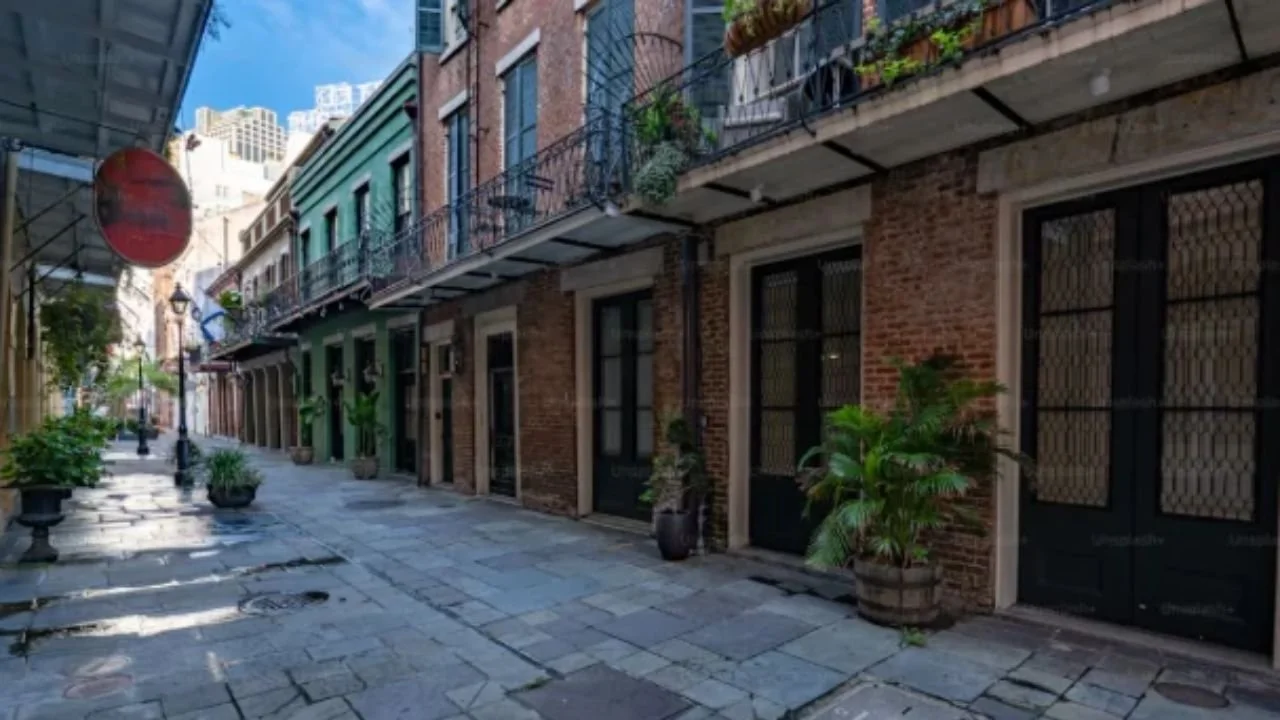
Exchange Place, New Orleans, is easy to walk past. It is a narrow passage near Canal Street, squeezed between bigger streets and bigger names. Yet its paper trail starts in 1831. There are very few stories in French Quarter history with such clear records.
Historic alleys in New Orleans show what famous landmarks leave out. Three threads run through this story:
Origins: How a surveyor's plan created the passage in 1831.
Commerce: The Merchants' Exchange and the trade, gambling, and slave auctions around it.
Civil rights: A school that opened on Exchange Place in 1965.
This account of Exchange Place draws on archival records, historical research, and published sources.
How Exchange Place Came to Be
Exchange Place was created in 1831. This date anchors the history that follows. The street was not part of the original city plan drawn by Bienville and Pauger.
The Paper Trail
The Historic New Orleans Collection's Vieux Carré Digital Survey holds the key record. It is a plan by City Surveyor Joseph Pilié, dated October 3, 1831. The plan's title begins "Plan of the ground ceded to the city corporation for Exchange Place." A notary attached it to an act dated November 3, 1831.
The same survey shows the first buildings:
An 1832 deed describes a Chartres Street lot whose back faced "the new street called Exchange."
The buildings at 110–112 Exchange Alley date to about 1832–33.
They are three-story brick, in the Federal style, with fan-shaped transoms over the doors.
A city landmarks report says the whole row went up around the time the alley opened.
Where the Passage Ran
The passage began at Canal Street. It passed the Merchants' Exchange on Royal Street and crossed Iberville and Bienville streets. Then it ran through the St. Louis Hotel at St. Louis Street. So it linked two of the era's biggest exchanges.
The Louisiana Supreme Court building, finished around 1910, covers part of the route. The stretch past Toulouse Street never fully opened.
One Street, Several Names
| Name | Where it appears |
|---|---|
| Exchange Passage, Passage de la Bourse | Early names. The survey includes a c. 1840 sketch using the French name. |
| "The new street called Exchange" | An 1832 deed |
| Exchange Place | The 1831 plan and an 1859 deed |
| Exchange Alley | The modern name for the block near Canal Street |
| Cabildo Alley | The last stretch, from St. Peter Street to Pirates Alley |
The records use Exchange Alley and Exchange Place for the same street.
The Merchants' Exchange and a City Driven by Trade
Banker and merchant Samuel Jarvis Peters led the plan for the Merchants' Exchange. He belonged to the Anglo-American business community. This group was building its own district across Canal Street. Peters raised $100,000 through a joint-stock company. In 1835, the company hired architects James Gallier Sr. and Charles Dakin. The building opened in 1836, per Richard Campanella's history for the Preservation Resource Center.
A Building Made for Business
The exchange stood at 18 Royal Street in the old numbering. Today that is 124–132 Royal Street. Its back faced Exchange Place. The lot measured just 80 by 120 feet. So the architects saved the drama for the inside.
Two three-story wings faced Royal Street and the alley.
A rotunda joined them, topped by a dome and skylight.
The outside was plain Greek Classical.
The building also did many jobs at once.
| Floor | What it held |
|---|---|
| Ground | Auction rooms, trading floors, a U.S. Post Office, a barroom and offices |
| Second | A reading room ($10 a year), a city court and the federal district court |
| Third | A billiard club and parlors for chess and conversation |
Creole Rivals and American Newcomers
The site sat between two worlds. One was the older Creole core along Chartres and Royal streets. The other was the American sector across Canal.
The Creole community answered with its own giant. It built the St. Louis Hotel, called the Exchange Hotel at first. The community rose in response to the Anglo-American St. Charles Hotel. The alley ran between these rival centers.
It’s important to not mix this building up with another exchange. A separate, older one stood at 501 Chartres Street. It began as Tremoulet's New Exchange Coffee House and later became Hewlett's Exchange. Our post on Pierre Maspero's covers this related story in detail.
Behind the Commerce: Gambling, Auctions, and Slavery
Exchanges did more than host deals. In the 1810s, one could serve as a coffee house by morning and a saloon at night. It also worked as a market, a job board, and a news hub. Merchants, travelers, and brokers crossed paths there.
Drinking and Gambling
Accounts of the area describe plenty of vice:
Charles Hicks ran a cockpit at the corner of Exchange Passage and St. Louis Street.
Hewlett's Exchange had billiards and gambling tables upstairs.
The St. Louis Hotel bar gave free lunch to anyone who bought a drink.
After its decline, the Merchants' Exchange itself housed an illegal gambling hall.
The Trade in Human Beings
The wealth of this district rested on slavery. Sales of enslaved people were public, routine, and legal. They were central to the local economy. The documented examples include:
The post office moved to the Customs House in 1861. The Associated Auctioneers then rented the Merchants' Exchange rotunda. They held real estate and slave auctions there.
Slave sales there went on for weeks after Union forces took the city in May 1862.
Hewlett's Exchange hosted auctions that included people.
The St. Louis Hotel had an auction block beneath its rotunda. Enslaved people were held in pens around the Quarter until sale.
Behind every sale stood a human being. The same economy supported the reading rooms, the bars and the grand domes.
What the Records Do and Do Not Show
These records point to the Merchants' Exchange and the buildings around it. The sources used here do not describe a slave auction on the alley itself. That is why it’s crucial to distinguish the claims about buildings from claims about Exchange Place.
What Historic Photographs Reveal About Exchange Alley
The Library of Congress holds two catalogued photographs of Exchange Alley in New Orleans.
| Photograph | Date | Catalog note |
|---|---|---|
| Exchange Alley and entrance to Royal Hotel, New Orleans | About 1900–1906 | The title names the entrance to the Royal Hotel |
| Exchange Alley, New Orleans | 1920–1926 | Photographer: Arnold Genthe |
The Years Around Each Photo
Over the decades, the Merchants' Exchange lost its edge. Specialized exchanges drew traders away. Cotton came first in 1871. Produce followed in 1880, sugar in 1883, and stocks in 1906. The old building later held a gambling hall, a restaurant, and a boarding house. In 1903, a fire damaged its dome.
Courthouse work also changed the neighborhood. Demolitions began in 1903. The Supreme Court building rose around 1910. The first photograph predates that building. The second came after it.
| Year | Event |
|---|---|
| 1831 | Pilié's plan for Exchange Place |
| 1836 | Merchants' Exchange opens |
| 1861–62 | Slave auctions in the rotunda |
| 1903 | Dome fire and courthouse demolitions begin |
| About 1900–1906 | First photograph |
| About 1910 | Supreme Court building finished |
| 1920–1926 | Genthe photograph |
What Photographs Can and Cannot Tell Us
Archival photos let you check physical details. You can look at the width of the passage, the street surface, and the building fronts. You can read signs, count wires, and study balconies.
The images offer a glimpse of Exchange Place at two points in time. But they cannot tell you who walked there and why. Only historical documents can help explain who used the passage and what happened there.
Exchange Place's Overlooked Civil Rights Story
The Exchange Place name carries a second story from the 1960s. The 431 Exchange tells it through a history page and a 12-episode podcast.
A School on a Dark Street
On Monday, December 13, 1965, about ninety women arrived at the Adult Education Center. Most were African American, and many were working mothers. The school trained women for secretarial jobs in offices that had long excluded them.
Director Alice Geoffray was 41 and the mother of seven. Her secretary, Sharon Rodi, opened the doors at 8 a.m. Each student punched a time card, as practice for a real job. Classes began at 9 in typing, shorthand, and speech rooms.
The Barriers
Father Timothy Gibbons, a Dominican priest from Illinois, founded the program. His superiors removed him from New Orleans on the eve of opening.
Sixty landlords refused to rent space to the school. James Coleman Sr. finally offered a building.
The first class was shut down after white residents objected.
A hurricane that fall stirred racial tension. Plans to desegregate white offices drew political fights. Federal funding arrived only days before opening.
What the Graduates Achieved
The 431 Exchange reports that 94% of graduates found jobs paying well above their old wages.
The school graduated 431 women between 1965 and 1972.
By 1967, The Wall Street Journal and Time had covered it.
Graduate Patricia Morris testified before a U.S. Senate subcommittee in 1968.
Carol Cole joined the first class. She became one of the first African American secretaries at a major oil company.
A 1968 funding cut nearly ended the school. Supporters revived it. An Emmy-winning documentary, The School That Would Not Die, told that story.
The school closed in 1972.
These graduates were among the first Black secretaries in the city's businesses.
How Exactly Does It Connect to the Alley?
The school was on Exchange Place, about half a block from Canal Street. It occupied a space once used for bars and illegal gambling. However, published accounts do not give the school’s exact street address. We know the school and these earlier businesses were linked to Exchange Place. But the sources do not confirm their exact locations along the alley.
What Exchange Place Tells Us About New Orleans Today
One narrow passage holds three eras. First came merchants and their exchanges. Then came auctions that sold human beings. Later, a classroom opened a door to office work for Black women. Each era reflects who held power in the city.
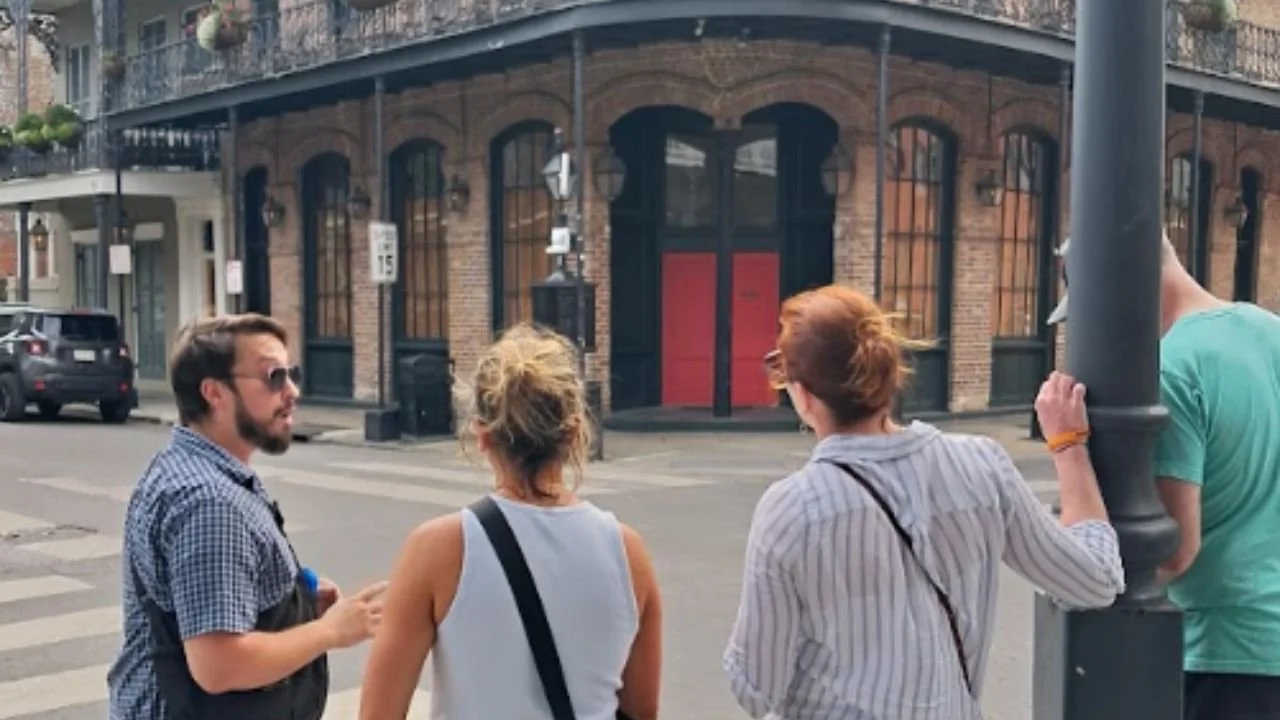
Good history separates what is documented from what is not. That is the standard Hottest Hell Tours sets for itself. Our guides are New Orleanians and historians who draw on documents. They flag legends before telling them. They do not promise ghosts, and they reject fiction passed off as truth.
Our flagship Walking the Devil's Empire tour follows that approach:
It is an adults-only walk of about 1 hour 45 minutes.
Groups are capped at 20 people.
It starts at the front entrance of Armstrong Park, 801 N. Rampart St.
Routes vary by guide and week. Stops may include Congo Square and Marie Laveau's house.
The Stories a Small Alley Keeps
Exchange Place is more than a narrow passage. A surveyor's plan created it in 1831. Merchants used it to move between rival exchanges. The same commercial world traded in enslaved people. In 1965, a school on Exchange Place gave Black women a way into office jobs.
Those three chapters share one name. Each can be traced to a record. A plan, a deed, a photograph and a graduate's story all survive. None needs an invented detail.
New Orleans' darker history is powerful on its own. The French Quarter's smallest streets often carry its longest records. The next time you pass a narrow opening, ask what it once connected. The answer may be in an archive.
Frequently Asked Questions
1. Where is Exchange Place in New Orleans?
Exchange Place is a French Quarter passage that begins near Canal Street. The block closest to Canal is called Exchange Alley. The street passed Royal Street and ran through the St. Louis Hotel. The Supreme Court building later covered part of it.
2. When was Exchange Place created?
City Surveyor Joseph Pilié drew the plan for Exchange Place on October 3, 1831. An 1832 deed calls it "the new street called Exchange." The street was not part of the original city plan. It served a growing business district.
3. What was the Merchants' Exchange?
The Merchants' Exchange was a business hub at 124–132 Royal Street. Samuel Jarvis Peters planned it, and Gallier and Dakin designed it. It opened in 1836. It held auctions, a post office, courts, a reading room, and a billiard club.
4. What was the Adult Education Center on Exchange Place?
The Adult Education Center opened on December 13, 1965. It trained mostly African American women for secretarial jobs. Alice Geoffray directed it, and about ninety women began classes. It closed in 1972. The 431 Exchange now preserves its full story.