
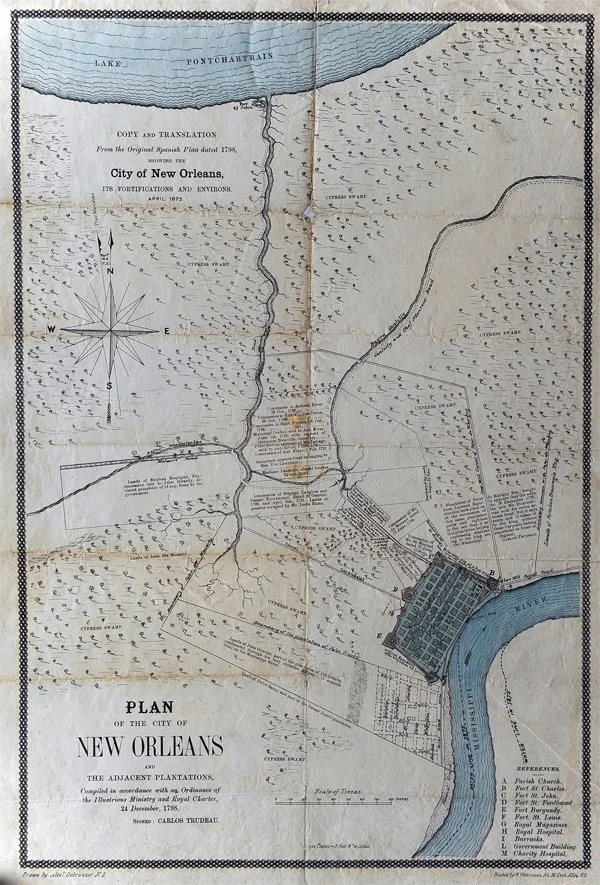
Credit: https://64parishes.org/entry/spanish-colonial-louisiana
Spanish Louisiana shaped New Orleans in ways many people never learn. Yet this chapter often hides behind French myths and American legends. However, Spanish rule lasted longer than many may expect. Because of that, its influence still echoes through the city today.
This story feels quiet, heavy, and deeply human. It carries voices of power, survival, fear, and faith. More importantly, it holds forgotten lives and unseen struggles.
What Was Spanish Louisiana
Spanish Louisiana began in 1762 through a political exchange. France secretly transferred Louisiana to Spain. This deal happened through the Treaty of Fontainebleau. Spain wanted a buffer against British expansion.
Although France handed over control, culture did not shift instantly. French language, religion, and customs remained strong. However, Spanish law and power slowly reshaped daily life. This created a layered colonial identity that still defines the city.
Spanish Louisiana lasted until 1801. France briefly regained control before selling the territory; in 1803, it becamethe Louisiana Purchase transferring it for three cents an acre to the United States. These rapid changes left cultural confusion and social tension.
Why Spain Wanted Louisiana
Spain saw Louisiana as strategic protection. The British controlled large North American territories. Spain feared British control of the Mississippi River. Therefore, Louisiana became a defensive buffer zone.
New Orleans also offered economic value. The port connected the Caribbean, Europe, and inland America. Trade routes shaped imperial power. Control of waterways meant control of wealth.
Daily Life Under Spanish Rule
Life under Spanish rule felt strict, structured, and deeply religious. However, daily life also changed in complex and unexpected ways. Catholic institutions gained stronger authority across public and private life. Church records slowly replaced many French civil systems. As a result, marriage, birth, and death became church-controlled records.
Spanish law reshaped how society functioned across every class. Property systems became more organized and legally defined. Women gained stronger inheritance and property rights than under French rule. However, freedom still depended on race, wealth, and legal status.
One important change came through the coartación system, which allowed enslaved people to purchase their freedom over time. This system did not end slavery. Yet it created rare legal pathways toward manumission. This is one of the reasons New Orleans had , a growing free Black population..
Over time, the gens de couleur libres, or free people of color, formed strong communities. They built businesses, churches, and social networks. Many became artisans, traders, and property owners. These communities reshaped New Orleans society quietly but permanently.
At the same time, enslavement expanded under Spanish administration. The slave trade became more organized and far more aggressive. Enslaved people were imported from the Caribbean in large numbers. During Spanish rule, the enslaved population grew from roughly 4,500 to nearly 35,000 people.
Plantations expanded across Louisiana’s landscape. Agriculture shifted toward more brutal labor systems. Tobacco and indigo slowly gave way to sugar and cotton production. These crops demanded intense labor and harsher exploitation.
Spanish Louisiana also changed through immigration. Canary Islanders, known as Isleños, were brought to the region by Spain. They settled rural areas and built farming communities. Their culture still influences Louisiana traditions today.
Daily life under Spanish rule held deep contradictions:
Legal structure expanded
Religious authority increased
Free Black communities grew
Enslavement intensified
Agriculture became more brutal
Cultural diversity expanded
The Fire That Changed Everything
Two massive fires reshaped New Orleans forever. The first great fire struck in 1788 on Good Friday. That disaster destroyed 856 buildings across the colonial city. The second fire followed in 1794, destroying another 212 structures.
These fires erased much of the original French colonial landscape. Spanish officials then rebuilt the city with new rules and new materials. Wooden buildings were banned in central areas. Brick walls replaced fragile timber homes. Courtyards, thick masonry, and fire-resistant designs became standard.
After the 1788 fire, rebuilding began under dramatic conditions. The Catholic Church refused to ring the cathedral bells to raise the alarm. As a result, the flames spread faster through the city. Because of this failure, the Spanish governor personally funded rebuilding efforts.
Spanish rebuilding shaped the city’s most famous landmarks. Structures that still stand today include:
St. Louis Cathedral
The Cabildo
The Presbytère
These buildings reflect Spanish architectural planning and colonial power. Their thick walls and stone design were meant for permanence and protection. Over time, this style defined the city’s identity.
Because of this rebuilding, the French Quarter looks Spanish-Caribbean today. Iron balconies replaced French wooden galleries. Stone courtyards replaced open timber yards. Many visitors mistake this style as French, but its roots are Spanish.
New Orleans became a new city after the fires. Disaster created transformation. Destruction created permanence. Spanish design turned tragedy into lasting structure.
Spanish Louisiana and Religion
Catholicism became deeply rooted in public life. Church authority shaped morality and social structure and public rituals reinforced spiritual control. Faith became political power.
Cemeteries reflected Spanish religious traditions and burial practices followed Catholic doctrine.
Churchyards became sacred spaces.
Hidden Voices of Spanish Louisiana
History often focuses on powerful colonial leaders and official stories. Yet everyday people carried the true weight of colonial rule. Enslaved Africans shaped labor systems and cultural traditions across the region.
Free people of color built strong communities and lasting local businesses. Meanwhile, Native communities faced violence, displacement, and broken land ties. Over time, colonial survival always demanded a deep and lasting human cost.
A Simple Timeline of Spanish Louisiana
1762
Event: France transfers Louisiana to Spain.
1769
Event: Spain formally takes control of New Orleans and the Louisiana territory.
1788
Event: The Great New Orleans Fire of 1788 destroys much of the city.
1794
Event: The Great New Orleans Fire of 1794 further reshapes the city’s architecture and layout.
1800
Event: The Louisiana territory is returned from Spain to France.
1803
Event: The Louisiana Purchase is completed, transferring the territory to the United States.
Bernardo de Gálvez and the American Revolution
Spanish Louisiana played a quiet role in the American Revolution. Much of that role came through Governor Bernardo de Gálvez. He used New Orleans as a hidden supply port for the rebel colonies.
Instead of open alliances, Spain worked through silent support. Weapons, gunpowder, medicine, and supplies moved through the Mississippi River. These supplies traveled north to American forces without public declarations of war.
New Orleans became a lifeline for the revolution. Spanish ships carried aid while avoiding British detection. Trade routes became resistance routes disguised as commerce.
Later, Gálvez moved from support to direct action. He led Spanish military campaigns against British forts along the Gulf Coast. These victories weakened British power in the southern colonies.
Key campaigns led by Bernardo de Gálvez:
Location: Baton Rouge
Year: 1779
Outcome: British fort captured
Location: Mobile
Year: 1780
Outcome: British control removed
Location: Pensacola
Year: 1781
Outcome: Major British stronghold defeated
These victories changed control of the Gulf region. British supply lines collapsed across the southern frontier. Spanish Louisiana became a military force, not just a colonial territory.
Gálvez became a hero in Spanish history. However, American history often forgets his role. Yet without Spanish support, the Revolution’s southern strategy would have struggled.
New Orleans was not just a port city. It became a quiet engine of independence. Spanish Louisiana helped shape American freedom without public recognition.
This story shows how colonial power sometimes supported liberation. It also proves how hidden alliances change history quietly. Spanish Louisiana influenced far more than its borders.
Key Spanish Governors of Louisiana
Spanish Louisiana was shaped by powerful colonial leaders. Their decisions controlled fear, order, and daily survival. Each governor left a deep mark on the colony’s future.
Antonio de Ulloa
Antonio de Ulloa became the first Spanish governor of Louisiana. He ruled quietly and avoided public authority displays. However, colonists rejected his leadership and forced his removal. In 1768, rebellion drove him from New Orleans without bloodshed.
Alejandro O’Reilly
Alejandro O'Reilly arrived with troops to restore Spanish control. His rule relied on fear, trials, and public executions. Several rebel leaders died under his orders. History remembers him as “Bloody O’Reilly” for this reason.
Bernardo de Gálvez
Bernardo de Gálvez ruled with military vision and political skill. He supported the American Revolution through New Orleans supply routes. Later, he captured British forts along the Gulf Coast. His leadership reshaped Spanish power in the region.
Francisco Carondelet
Francisco Carondelet governed during growing colonial fear. He worried about slave revolts after the Haitian Revolution. As a result, surveillance and control systems expanded. Security replaced trust across colonial society.
The Louisiana Rebellion of 1768
Spanish Louisiana faced open resistance very early. French colonists rejected Spanish control after the colonial transfer. Many settlers felt betrayed and politically abandoned. As a result, anger slowly turned into organized rebellion.
In 1768, colonists rose against Antonio de Ulloa, the first Spanish governor. They accused him of weak leadership and harmful trade policies. Crowds forced him to leave New Orleans without bloodshed. For a short time, the colony returned to French control.
However, Spain did not accept that outcome. The crown sent Alejandro O'Reilly to restore order. He arrived in 1769 with twenty-four ships and two thousand troops. His mission was control, not negotiation.
O’Reilly arrested the rebellion’s leaders soon after arrival. Trials followed under Spanish military authority. Several leaders were executed in public. These executions marked Spain’s first harsh political punishment in the colony though, executions had occurred earlier under French rule. It was carried out by Louis Congo, an enslaved man who served as the colony’s executioner in exchange for his and his family’s freedom.
Fear spread quickly through the colony. Spanish authority became absolute and unchallenged. From that moment, resistance shifted into silence. Colonial rule hardened into control through fear and punishment.
Quick facts about the rebellion:
Event: Uprising year
Historical reality: 1768
Event: Target
Historical reality: Spanish colonial rule
Event: Governor expelled
Historical reality: Antonio de Ulloa
Event: Spanish response
Historical reality: Alejandro O’Reilly sent with troops
Event: Troop count
Historical reality: About 2,000 soldiers
Event: Ships
Historical reality: Twenty-four Spanish vessels
Event: Outcome
Historical reality: Rebel leaders executed
Event: Historical impact
Historical reality: First political executions in Louisiana
The Silent Systems of Control
Spanish Louisiana operated through a system of quiet authority. Military power enforced colonial law across everyday life. Church influence shaped moral behavior and public identity. Economic control maintained strict social hierarchies in society.
As a result, people lived under many layers of pressure. Race often determines access to freedom and safety. Wealth usually decided who held lasting power. Faith shaped social belonging and acceptance.
Cultural Traces Still Visible Today
Spanish Louisiana still lives in the streets. Iron balconies reflect Spanish design. Courtyard homes reflect Mediterranean architecture. Brick walls echo fire prevention laws.
Legal traditions still reflect Spanish codes. Property rights evolved under Spanish systems. Family law followed Catholic structures. Even street layouts reflect colonial planning.
Spanish Louisiana and the Fear of Rebellion
Colonial leaders feared uprisings constantly. Slave revolts terrified Spanish officials and Haitian revolution stories spread fear. Control became stricter as anxiety grew.
Surveillance increased across communities and movement became more restricted.
Gatherings were monitored closely. Freedom felt fragile and conditional.
The Emotional Weight of Colonial Rule
Spanish Louisiana carried constant tension through everyday life. Because of that pressure, fear shaped daily choices and behavior. Survival often required silence, caution, and careful obedience. Still, hope lived quietly inside families and close relationships.
Over time, people learned to adapt without drawing attention. As a result, resistance became subtle rather than open. Faith offered refuge during uncertain and dangerous times. Community bonds slowly became the strongest form of protection.
The Ghosts That Still Linger
These histories never fully disappear. They settle into buildings and streets and live in oral stories and traditions. They exist in unmarked graves and forgotten names.
Spanish Louisiana created silent scars. Those scars still shape New Orleans identity.
Why Spanish Louisiana Matters Today
Understanding Spanish Louisiana changes everything. It reframes New Orleans history. And deepens cultural awareness. It also exposes erased stories.
Without this chapter, history feels incomplete. With it, the city becomes clearer.
The past feels more human and the ghosts feel more real.
Where Forgotten Voices Still Speak
At Hottest Hell Tours, history is never sanitized. Stories are told with truth and respect.
Colonial power structures are never romanticized. Human experiences always come first.
Our tours explore hidden histories. They focus on silenced voices and erased narratives.
Spanish Louisiana becomes more than dates and names. It becomes lived memory and lived pain.
The stories we tell in our tours are not tourist myths. They are historical truths that are carefully researched and shared with responsibility.
If you want real history, not fantasy, our tours will satisfy you. If you want depth, not gimmicks, this is the path. If you want stories that matter, start with us. Because some ghosts deserve to be remembered.