

Credit = Wikipedia
The only criminal trial ever brought in connection with the assassination of President John F. Kennedy did not happen in Dallas. It happened in New Orleans, in a courthouse on Royal Street. Yet, most people who visit this city have no idea about it.
Why New Orleans Is at the Heart of the JFK Story
Most Americans think of Dallas when they think of the Kennedy assassination. That's the setting.
The only person ever formally charged in connection with the assassination was a New Orleans man. He was tried in a New Orleans courtroom, by a New Orleans district attorney. The attorney believed the whole thing had been cooked up right here in Crescent City.
New Orleans in the early 1960s was a city steeped in Cold War intrigue. Anti-Castro Cuban exile groups operated openly. Former intelligence operatives kept offices off Canal Street. Lee Harvey Oswald was the man the Warren Commission named as the sole assassin. He handed out pro-Castro leaflets on the streets of the French Quarter in the summer of 1963. He lived here. He was known here, by people whose names would appear again and again in the years that followed.
Jim Garrison and the Case That Shook the Country
In 1966, New Orleans District Attorney Jim Garrison began taking a second look at the Kennedy assassination. He was a former FBI agent. By most accounts, he was one of the sharpest legal minds in Louisiana.
Garrison's investigation traced back to a street-level fight. Kennedy was shot on November 22, 1963. On this day, a man named Guy Banister pistol-whipped his own associate, Jack Martin, in a New Orleans office. Martin, bleeding and furious, started proclaiming that Banister and a man named David Ferrie had known Lee Harvey Oswald. That Ferrie might have been a part of the assassination itself.
Ferrie was a former Eastern Airlines pilot with a strange reputation. He wore a red toupee and had drawn-on eyebrows. He knew Oswald from the Civil Air Patrol in the late 1950s. On the night of the assassination, he drove from New Orleans to Houston for reasons he couldn’t ever properly explain. The FBI interviewed him but couldn't build a case. So, they let him go.
Garrison picked up that thread three years later. He started connecting dots. Ferrie, Banister, and a third man. This third man was Clay Shaw. He was a prominent New Orleans businessman and director of the International Trade Mart. Shaw was a cultivated man who had helped restore much of the French Quarter. He was deeply respected in the city.
On March 1, 1967, Garrison arrested Clay Shaw. He charged him with conspiring to assassinate President Kennedy.
Clay Shaw: New Orleans' Most Unlikely Suspect
It’s important to understand who Clay Shaw was. He was New Orleans royalty. A playwright. A preservationist. A decorated World War II veteran.
Garrison's theory was that Shaw, Ferrie, and Oswald had met together. They had plotted Kennedy's murder. What motivated them was fury over Kennedy's foreign policy. They were angry at his reluctance for a military solution in Cuba and his quiet overtures toward the Soviet Union. Garrison believed right-wing extremists, CIA operatives, and anti-Castro exiles were together. Shaw was a linchpin.
The problem was the evidence.
Garrison's key witness was a young man named Perry Russo. He claimed to have attended a party at David Ferrie's apartment where he overheard Ferrie, Oswald, and a white-haired man. Later that man was identified as Clay Shaw. He said it seemed like they were all discussing the assassination in chilling detail.
The problem was that Russo's testimony had been developed, in part, through hypnosis sessions and sodium pentothal. This was also called the truth serum. When the pre-hypnosis accounts were compared with what Russo said under hypnosis, there were notable differences.
Other witnesses had their own credibility problems. One was a heroin addict. Another testified that he had been repeatedly hypnotized by government agencies.
The Alias That Could Have Changed Everything
At the core of Garrison's case was a mysterious figure. The Warren Commission report called him "Clay Bertrand." A New Orleans attorney named Dean Andrews had testified to the Warren Commission. He received a phone call the day after the assassination from someone calling himself Clay Bertrand. The caller asked him to fly to Dallas to represent Oswald. Andrews later told the FBI that the whole story was a figment of his imagination. He then told the Warren Commission that he had only said that because of FBI pressure.
Garrison became convinced that Clay Bertrand and Clay Shaw were the same person. But his own investigator, Lou Ivon, sent a memo saying he could not find a single person who could confirm Clay Bertrand.
At trial, police produced a fingerprint card with Shaw's signature and a self-reported alias of Clay Bertrand. It could have been the smoking gun. But Judge Edward Haggerty threw it out. The arresting officer had taken Shaw's fingerprints. He asked about aliases without a lawyer present, violating Miranda rights. The judge declared, in open court, that he did not believe the officer's account of the arrest. The card was gone.
The Trial Itself: 54 Minutes and Not Guilty
The trial of Clay Shaw opened on January 29, 1969, at Orleans Parish Criminal Court. Garrison spent 42 minutes reading a 15-page opening statement. He promised the jury he would prove that Kennedy was shot from multiple directions. He also promised to give evidence that Shaw and Oswald had traveled together to Clinton, Louisiana months before the assassination.
Six surprise witnesses did testify that they had seen Oswald with Ferrie and Shaw in Clinton in the fall of 1963. Some of those witnesses were later deemed credible by the House Select Committee on Assassinations in 1979. It said that it was "inclined to believe" Oswald had been in Clinton with Ferrie. That's not nothing.
But the jury wasn't buying it. On March 1, 1969, they returned a not-guilty verdict after deliberating for just 54 minutes.
Some jurors, interviewed later, said they believed a conspiracy to kill Kennedy may have existed. However, Garrison had not connected Shaw to it. Others denied saying anything of the sort.
Shaw was free. But he was also destroyed. The arrest had cost him his career and most of his money. He died in 1974.
Oliver Stone Brought the Trial Back to Life
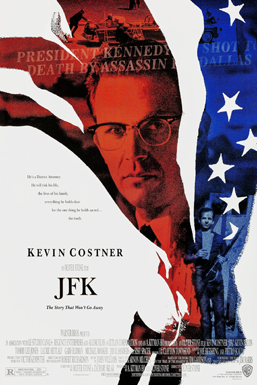
credit = Wikipedia
For most of the 1970s and 1980s, the Clay Shaw trial was seen as a silly event that had embarrassed everyone involved.
Then Oliver Stone made JFK in 1991. The film starred Kevin Costner as Jim Garrison. Stone used Garrison's own book On the Trail of the Assassins as its primary source. The movie reignited public debate about the Warren Commission. It led directly to the JFK Records Act of 1992. It forced the declassification of thousands of previously secret government documents.
Royal Street and the Weight of History
The courthouse where Clay Shaw was tried still stands on Royal Street. Walk past it on any given night and it looks like any other handsome building in this area.
New Orleans has always had a complicated relationship with truth. It's a place where official history and real history are frequently strangers to each other. Where the stories told in public and the stories whispered in the back rooms are rarely the same story.
The JFK trial is a perfect example. Here was the only criminal prosecution ever mounted for the assassination of a sitting American president. It was tried in a city that most of the country barely associated with the case. The trial ended in 54 minutes.
New Orleans doesn't do things the simple way.
The Kind of History Worth Walking Through
The French Quarter holds layers of truth like that on almost every block. Cases that were buried, burned, or quietly reclassified. The dark, documented history of this city is rarely what gets advertised.
That's exactly the kind of history that drives the tours offered by Hottest Hell Tours. Credentialed historians lead small groups through the actual historical record of this city. The verified stories. The unsettling ones. The kind that make you stop mid-block and ask, wait, this really happened here? Yes. All of it, right here. The truth in New Orleans has always been more disturbing than anything made up. The city’s stories deserve to be told properly, without embellishments.
Because a city that hosted the only JFK assassination trial in history, nearly had the evidence burned by a sitting district attorney, and produced a courtroom verdict that still generates arguments 55 years later? This city is not finished surprising you.
FAQs
Is the JFK movie a true story?
Oliver Stone's JFK is based on real people and historical events, but it is not a fully true story. The film mixes facts with fictional scenes and theories to create a dramatic narrative. Many historians and researchers agree that it should be viewed as a work of historical fiction rather than a documentary.
What were Jack Ruby's last words?
Before his death in 1967, Jack Ruby reportedly said he wanted the truth about the Kennedy assassination to be known and expressed concern that people would never fully understand what happened. Different sources record his final comments in different ways, so there is no single confirmed set of last words accepted by historians.
Why did Jackie Kennedy crawl to the back of the car?
After President Kennedy was shot, Jackie Kennedy climbed onto the back of the limousine. Secret Service agent Clint Hill later believed she was trying to reach a piece of her husband's skull that had been thrown onto the trunk. In the shock and confusion of the moment, she acted on instinct before being guided back into her seat.
How long did JFK survive after he was shot?
President John F. Kennedy was shot at about 12:30 p.m. on November 22, 1963, while riding in a motorcade in Dallas, Texas. He was rushed to Parkland Memorial Hospital, where doctors tried to save him. He was pronounced dead at 1:00 p.m., about 30 minutes after the shooting.