

Some ideas are so old they feel like instinct. The hungry ghost is one of them. Across thousands of years and dozens of cultures, the same figure keeps appearing. A creature forever reaching. Forever consuming. Never satisfied. In Buddhist tradition, this figure has a name, a precise anatomy, and a place in the cosmic order of things. Understanding it takes you deep into how Buddhism reads the human mind and what happens when desire goes wrong.
This is the full story of the hungry ghost in Buddhism, where it came from, what it looks like, and what it is actually pointing at.
What the Ancient Texts Say
The hungry ghost does not begin with Buddhism. The concept is older than any single religion. One of its earliest references appears in Hindu scripture.
The Garuda Purana, a text within the Vedas, addresses the origin of these beings directly:
"The Lord said: It is the men of sinful actions actuated by their previous misdeeds who become ghosts after death. Please listen to me, I shall tell you in detail." Garuda Purana, Vedas, verse 2.22
The text then gives specific origin stories for individual hungry ghosts. One account describes a man who robbed an elderly woman and her young son during their pilgrimage. He took their food, their clothes, and frightened the boy away from the only water available. The child died of thirst. The mother, overcome with grief, threw herself into a dry well and died too.
The Garuda Purana records the consequence in the ghost's own words:
"O brahmana, by that sin I became a ghost with a mouth as small as the hole of a needle and body as huge as a mountain. Although I get food I cannot eat. Although I burn with hunger my mouth is contracted. Since in my mouth I have a hole equal to that of a needle I am known as Sucimukha." Garuda Purana, Vedas, Verse 2.7.53 - 2.7.61, translated by J.L. Shastri
The punishment fits the crime with precision. He denied others nourishment. Now he cannot receive it himself. The physical form of the hungry ghost is not arbitrary. It is a moral statement rendered in flesh.
The Pali Buddhist text Petavatthu also addresses hungry ghosts directly. Its first chapter, known as the Tirokudda Kanda, or "Hungry Shades Outside the Walls," describes spirits standing at doorways and crossroads, returning to old homes and waiting:
"Outside the walls they stand, and at crossroads. At door posts they stand, returning to their old homes. But when a meal with plentiful food and drink is served, no one remembers them: "Such is the kamma of living beings." Petavatthu Verse 1.5, translated by Thanissaro Bhikkhu, 2010
These lines are not metaphor. The text treats the hungry dead as a literal pastoral concern. Offerings to departed relatives were a sincere religious duty. The poem continues with instructions for the living: make timely donations of proper food and drink, and the dead may receive benefit. The ritual transaction between the living and the hungry dead had real social weight.
The Physical Form of the Hungry Ghost
Across every tradition that describes hungry ghosts, the physical description is consistent. That consistency across cultures and centuries is worth pausing on.
The hungry ghost appears as a human-shaped wraith with mummified skin. Its limbs are thin and withered. Its stomach is enormous and grossly distended. Its throat is narrow and its mouth is tiny, sometimes described as the size of a pinhole. The creature is perpetually starving. Its form makes satisfaction physically impossible.
In Buddhism, the Sanskrit term for these beings is preta. In Pali, they are called peta. The Tibetan tradition uses yi-dwags. In Japan, they are called gaki. The name changes, but the image does not.
Hungry ghosts are described in Buddhist, Taoist, Hindu, Sikh, and Jain texts. They appear across Southeast Asia, from the Philippines to Japan, from China to Thailand, Burma, India, and Pakistan. The universality of the figure suggests it is responding to something deep and shared in human experience.
Their specific torments vary. Some hungry ghosts can find no food or water at all. Others can find both, but their pinhole mouths make swallowing impossible. For others, food ignites into flame or rots in the moment of consumption. Japanese Buddhist tradition describes certain gaki, called jikininki, that are cursed to consume human dead bodies. Others, called gaki proper, must eat excrement. According to Hindu tradition, some hungry ghosts are condemned to endlessly seek particular things they obsessed over in life: wealth, specific people, even the emotion of fear itself.
The Six Realms: Where Hungry Ghosts Live in Buddhist Cosmology
To understand the hungry ghost in Buddhism, you need to understand where it lives. Buddhism organizes cyclic existence into six realms, known collectively as samsara. These realms are depicted on the Tibetan Wheel of Life, the bhavachakra, a visual map of the cycle of birth, death, and rebirth.
The six realms are the realm of the gods, the realm of warring gods, the human realm, the animal realm, the realm of hungry ghosts, and the hell realm. The hungry ghost realm, preta-loka, sits one step above the lowest realm, hell.
Lion's Roar, a leading Buddhist publication, describes the preta realm as defined by "attachment and the truth that we can never end the suffering of unquenched desire, no matter how much we consume." Each realm is associated with a particular mental obscuration. The hungry ghost realm corresponds to craving and insatiable wanting.
On the Wheel of Life, each realm is not simply a place you go after death. Each realm is also a mental state you can inhabit right now. Buddhism uses the six realms as a map of the mind as much as a map of the afterlife. The hungry ghost realm is the state of being driven entirely by craving. It is the condition of someone for whom enough never arrives.
Where Hungry Ghosts Are Found in the World
Hungry ghosts are not confined to the preta realm in Buddhist cosmology. Several traditions describe them wandering among the living. They inhabit shadowy and dismal places. They stand at crossroads. They wait at doorways. They linger near places connected to their former lives or their former desires.
In China, Buddhist and Taoist traditions converge on this point. The spirits of dead ancestors are thought to return to the earthly realm during the seventh month of the Chinese Lunar Calendar. This period is known as Ghost Month or the Hungry Ghost Festival. During this time, offerings of food, fruit, and cake are left out for visiting spirits. Incense is burned. Amulets are worn against ghosts with malicious intent. The living maintain a careful relationship with the dead.
The connection to Halloween in the West is not accidental. Both traditions point to a time when the boundary between the living and the dead grows thin. The candle in a jack-o'-lantern, placed at the window, has a dual purpose in this older reading. It guides the beloved dead home while warning away the hungry ones.
Why They Become Hungry Ghosts: The Role of Karma
In Buddhist and Hindu tradition alike, the hungry ghost state is not random. It is the direct consequence of specific actions carried out in life. The key mechanism is karma, the moral weight of intentional actions.
Greed is the most commonly cited cause. A person who lived a life of hoarding, theft, extreme selfishness, or obsessive acquisition may be reborn in the preta realm. Cruelty during life, denying others food or resources, and actions driven purely by insatiable desire are all identified as causes.
The Garuda Purana is explicit. The hungry ghost Sucimukha was condemned not to some vague moral failing, but to a specific consequence of a specific act: he denied water to a dying child. The punishment mirrors the crime exactly.
Buddhism emphasizes that no state in samsara is permanent. Even the hungry ghost realm can eventually be left behind. The Buddhist tradition of making offerings, dana, is partly motivated by compassion for beings in the preta realm. Monks perform rituals specifically aimed at transferring merit to hungry ghosts, releasing them from their condition.
The Petavatthu records this principle directly:
"As water raining on a hill flows down to the valley, even so does what is given here benefit the dead. As rivers full of water fill the ocean full, even so does what is given here benefit the dead."
Merit flows downward. The generosity of the living reaches even those trapped in the hungry ghost realm.
The Grigori: A Hungry Ghost in Christian Mythology
The hungry ghost figure is not limited to Eastern traditions. A form of hungry ghost appears in Christian mythology as well. In the Book of Enoch, a text outside the canonical Bible but influential in early Christian and Jewish thought, the Grigori are described as fallen watchers who mated with human women. Their offspring, and the Grigori themselves, wander the earth in a state of permanent craving. They have no mouths that they can use to eat or drink with. They cannot satisfy any need.
The parallel to the preta is striking. Different religious lineages, separated by geography and centuries, arrived at the same image: a being that cannot satisfy its own hunger, condemned by its own past actions to want forever.
The Psychological Reading: Hungry Ghosts as Inner States
Buddhist tradition has always held that the six realms describe states of mind as much as literal places. The hungry ghost realm is perhaps the easiest to recognize in daily life.
Psychologist Gabor Maté explored this directly in his book In the Realm of Hungry Ghosts. Maté spent years working with severely addicted patients in Vancouver. He found the Buddhist metaphor precise. His patients were not simply making bad choices. They were caught in cycles of craving and temporary relief that mirrored the hungry ghost's condition exactly. The substance provided momentary satisfaction. The craving returned immediately, larger than before.
As the Spiritual Naturalist Society observes, the Buddhist teaching is that people get stuck in the hungry ghost realm partly because they refuse to confront the deeper pain beneath the craving. The addiction soothes a wound. But it never heals it. The wound grows larger in the dark. The craving must be fed more urgently to keep it quiet. This is precisely what the hungry ghost's body illustrates: the more you consume without addressing the root cause of your emptiness, the larger your belly grows and the smaller your mouth becomes.
The Buddhist framework is not moralizing here. It is describing a mechanism. Craving operates on its own momentum. It does not naturally exhaust itself. The only way out of the hungry ghost realm, in both the literal and psychological readings, is to address what is underneath the craving.
Lion's Roar notes that because humans are not as fixed in a particular mental state as other beings, our realm is "defined by choice and the possibility of enlightenment." Moment by moment, the human mind moves between states. The preta state is not a permanent sentence for the living. It is a recurring pattern that can be recognized and interrupted.
The Hungry Ghost Festival Across Asia
The ritual response to hungry ghosts produced some of the most enduring cultural practices in Asia. The Hungry Ghost Festival is observed on the fifteenth night of the seventh month of the Chinese Lunar Calendar. During Ghost Month, the gates of the underworld are believed to open. The dead roam freely. Hungry ghosts who have no living relatives to make offerings for them are particularly dangerous, because their hunger has no relief.
Offerings left during this period include food, paper money, and paper versions of goods the dead might need. Incense is burned continuously. Performances of opera or other entertainment are held in open spaces, with the front row left empty for ghost audiences. The rituals are simultaneously an act of compassion toward suffering spirits and a practical measure of protection for the living.
In Japanese Buddhism, the Obon festival carries a similar meaning. It is held in mid-August and involves lighting fires, floating lanterns on rivers, and welcoming the spirits of ancestors back to visit. The lanterns guide them home. The fires mark the way back.
Both festivals share the same understanding. The hungry dead have not gone away. They require attention. Neglect them and they suffer more. Attend to them and the boundary between the living and the dead becomes something navigable, even respectful.
What the Hungry Ghost Actually Teaches
The hungry ghost is not simply a scary story. It is a lesson in how desire works. Buddhism is very precise about this. Desire, or tanha in Pali, is one of the central causes of suffering in Buddhist teaching. The Second Noble Truth states that the origin of suffering is craving. The hungry ghost is the most vivid embodiment of that teaching.
The creature's body is a diagram. The enormous belly represents the scale of the craving. The tiny mouth represents the impossibility of satisfying it through consumption alone. No matter how much the ghost eats, the belly does not shrink. The craving is not a problem of quantity. It is a problem of structure.
Buddhism does not teach that desire is evil. It teaches that attachment to outcomes, and the belief that getting what we want will finally bring peace, is a form of ignorance that perpetuates suffering. The hungry ghost is what that ignorance looks like when taken to its extreme conclusion.
The realm of the hungry ghost, whether understood as a literal rebirth state or as a psychological condition available to any human being, points toward the same question. What are you trying to fill? And why do you keep believing that this next thing will be the one that finally does it?
Where New Orleans and the Hungry Dead Intersect
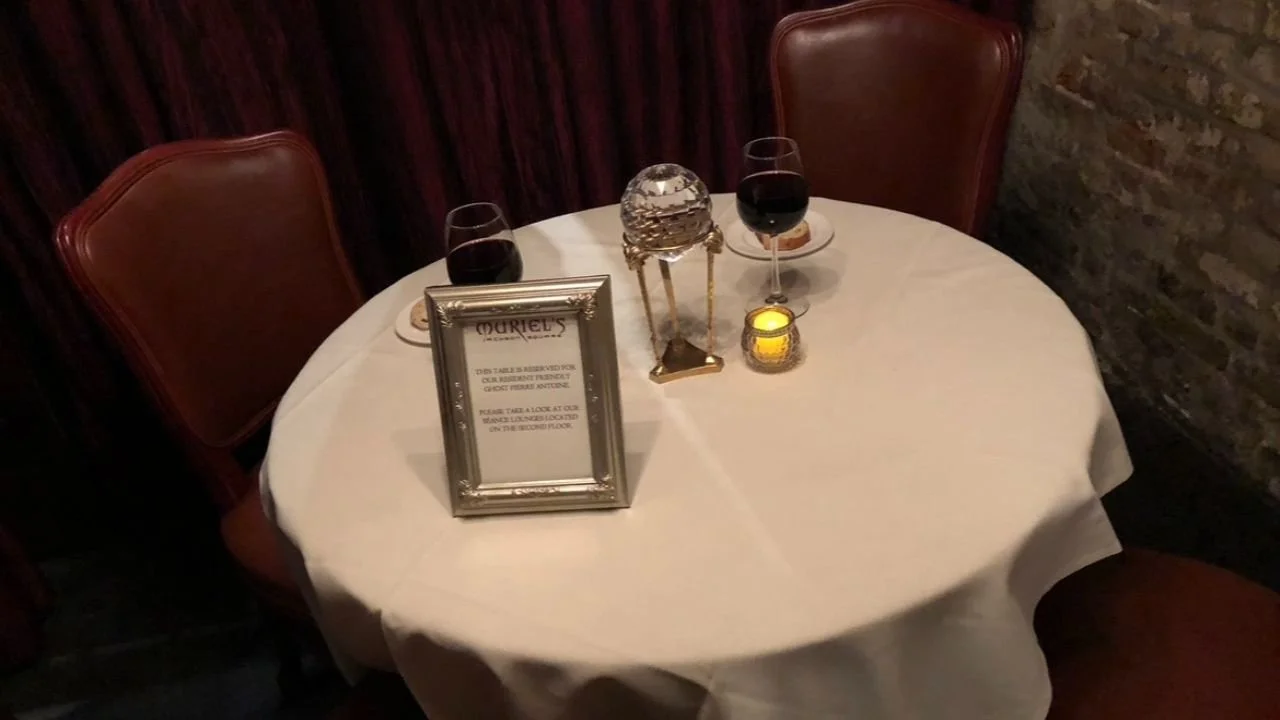
New Orleans has been talking to its dead for three centuries. The city was built on a relationship with loss. Its above-ground tombs, its jazz funerals, its traditions of remembrance, all reflect a community that did not believe the dead simply vanished. They lingered. They needed attention. The living and the dead maintained an ongoing conversation.
That is not so different from what the Petavatthu describes, or from what Buddhist monks perform when they make offerings for the dead. The forms are different. The underlying instinct is the same.
At Hottest Hell Tours, we take that instinct seriously. Our tours through the French Quarter do not treat the city's relationship with its dead as entertainment. They treat it as history. The stories of people who died here, of grief that accumulated over generations, of traditions built to manage that grief, deserve the same careful research that any historical subject demands.
Our tours are led by trained historians and published researchers. Every story on the tour is sourced. The hungry ghost tradition is uniquely similar to our approach. The ancient texts labeled specific ghosts with specific origins and specific causes. They did not generalize. They did not embellish. They documented. Just like we document history without any unnecessary decorations.
New Orleans is full of hungry ghosts in the metaphorical sense, and possibly in others. Come walk the streets where that history lives. It is darker and stranger and more precise than you expect.
Frequently Asked Questions
How does Buddhism describe hungry ghosts?
Buddhism describes hungry ghosts, or pretas, as beings tormented by insatiable craving. They are depicted with enormous bellies, withered limbs, and tiny mouths or pinhole throats. No matter how much they consume, their hunger is never eased. They represent the mental state of unquenchable desire and attachment, one of the six realms of samsara in Buddhist cosmology.
What is the Buddhist story of the hungry ghost?
One of the most detailed Buddhist accounts comes from the Petavatthu, a Pali text describing spirits haunting crossroads and doorways of their former homes. The Garuda Purana records a specific ghost called Sucimukha, condemned to a needle-sized mouth after denying water to a dying child during a pilgrimage. His physical form directly mirrors his past cruelty.
What is the difference between ghosts and hungry ghosts?
In Buddhist tradition, ordinary ghosts may include ancestor spirits who return during specific periods and can receive food offerings from the living. Hungry ghosts, or pretas, are specifically defined by the torment of insatiable craving caused by past karma. Their bodies make consumption impossible. They represent a particular state of suffering tied to greed, attachment, and moral wrongdoing during life.
What does Buddhism say about ghosts?
Buddhism acknowledges multiple categories of non-human beings, including gods, demons, animals, and spirits of the dead. Ghosts in the broader sense include ancestor spirits that may return during Ghost Month or Obon. Buddhism does not dismiss these beings as superstition. It places them within a structured cosmology where all beings cycle through realms based on karma until they achieve liberation from the cycle entirely.