
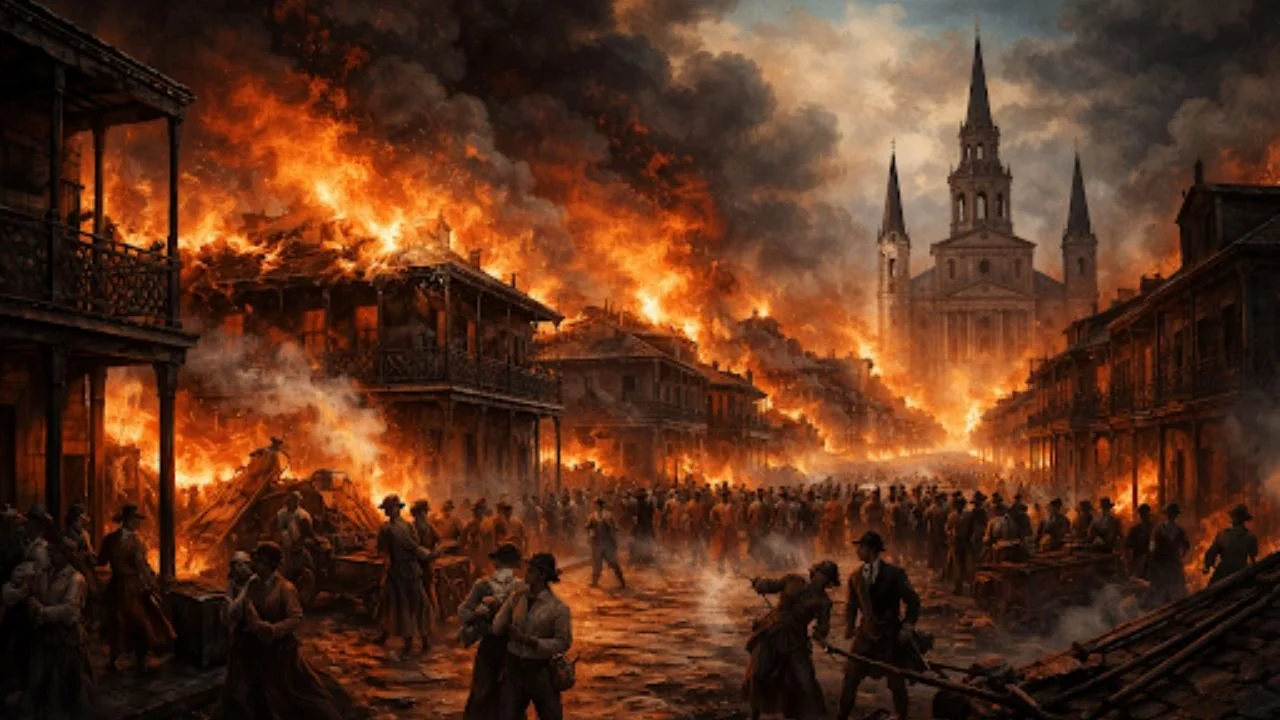
The great fire of New Orleans in 1788 changed the city overnight. Nearly every building in the French Quarter burned. Thousands of people lost their homes, businesses, and livelihoods. The fire left an imprint on the city’s culture, memory, and even its haunted reputation.
A Catastrophic Good Friday
The fire began at 1:30 PM, March 21, 1788. No one can say for certain the actual reason behind it. The event occurred on Good Friday. The location was the home of Don Vincente Jose Nuñez. He was the Army Treasurer. His home was located at 619 Chartres Street, corner of Toulouse.
A dire mistake made the aftermath of the fire worse. Père Antoine, the church priest, did not let the church bells be rung as a fire alarm. The reason? It was Good Friday, a holy day. Five hours was all it took for the fire to gobble the whole city. This happened so rapidly because the fire was fed by strong winds from the southeast.
The disaster ruined all significant buildings in the then-city. Today, it is known as the French Quarter. A few notable ones that were destroyed included:
Church
Municipal building
Army barracks
Armory
Jail
Out of the 1,100 structures in NOLA, 856 were ruined. Tents for the homeless were set up by Esteban Rodriguez, the colonial governor. In the coming six years, colonial officials built new masonry structures. These were solidly built, with thick brick walls and wrought iron balconies.
Economic and Cultural Consequences
The great fire of New Orleans caused severe immediate economic hardship. This, in turn, made way for long-term structural changes.
Immediate Economic Consequences
Destruction of Property and Goods
The fire incinerated major businesses. It also destroyed food warehouses and the city’s main bakeries. This led to acute food shortages. The city saw a loss of nearly 70 years of accumulated wealth.
Financial Loss
The initial loss was more than $1,080,000 (equivalent to roughly $25 million today). This did not include the loss of the merchandise. Later, the total losses were estimated to be more than $3 million (around $70 million in today’s dollars). This was nothing short of a devastating blow to the young colony.
Homelessness
Over 150 residents were left homeless. This initiated emergency relief efforts by Spanish colonial officials.
Key Cultural Consequences
The main cultural consequence of the fire can be seen in the city’s architecture. It forced a cultural shift toward a Spanish-colonial identity. Here are the major cultural consequences.
Architectural Transformation
The fire ended the prevalence of French-style wooden homes. New homes were built, made of stucco, brick, and tiled structures. These structures were the characteristics of Spanish colonial cities. Presbytere and Cabildo were two main structures built during this period.
Shift in Urban Planning
As per the new regulations, buildings had to be set near the sidewalk. It eliminated front gardens and trees. This altered the streetscape into a more urban environment.
Social and Economic Rebuilding
The New Orleans fire led to immense debt and homelessness. This led to a construction boom. It changed the city’s economic landscape at the core.
Increased Spanish Influence & Trade
The disaster cemented Spanish control. It led to stricter building codes. Simultaneously, it forced the opening of trade routes with the U.S. This was done to replenish destroyed supplies.
The "Shotgun" Home Influence
The new safety codes enforced more space between structures. So, narrow, deep houses began to appear. This influenced the development of the iconic "shotgun" house. However, these houses are not a direct result of the 1788 planning rules. Their emergence is part of the broader architectural evolution that stemmed from this New Orleans fire.
The Man Who Rebuilt New Orleans
When talking about the reconstruction of New Orleans, Don Andrés Almonaster y Rojas requires a special mention. He was a rich Spanish landowner and official. After the fire, he played the role of a philanthropist to recover religious and civic life in the city. Using his massive personal wealth, he funded many public institutions and infrastructure.
The buildings he supported included:
St. Louis Cathedral
The Cabildo
The Presbytere
Charity Hospital
A public school
Leper Hospital
A chapel for the Ursulines
Almonaster helped stabilize a city traumatized by fire. His efforts combined civic responsibility with personal devotion to New Orleans’ future. Even in death, he remained central to the city. Almonaster was buried in the floor of St. Louis Cathedral alongside his daughter, Andrea.
Human Stories Amid the Flames
Fires leave marks not just on buildings, but on memory. Anecdotes from survivors hint at narrow escapes and acts of bravery. Some people saved family heirlooms or religious objects. Others fled with nothing. Local legend says a few residents saw ghostly figures in the smoke, presaging later stories of haunted sites in the Quarter.
The haunted history of 1788 blends real fear with folklore. Many of today’s ghost stories trace back to this disaster. From whispers in alleyways to unexplained sounds in old homes, the fire’s shadow still lingers.
Why do these stories persist? Humans remember trauma collectively. Fires imprint on memory more than ordinary events. The first great fire of New Orleans left scars that were both physical and emotional. Neighborhoods were rebuilt. But the experiences of 1788 shaped generational memory.
Haunted stories often follow disasters. Ghosts of the fire symbolize loss, survival, and memory. They remind the city of what was lost and what endured.
Ethical Storytelling of Haunted Sites
When exploring stories of the fire, accuracy matters. Not every shadow is a ghost. Not every tale is true. Respecting lived history and separating folklore from fact is crucial. The fire was real. The destruction was documented. But the haunted stories are cultural interpretations, not sensationalized horror.
Understanding events like the great fire of New Orleans is what makes historical tours meaningful. Hottest Hell Tours focuses on ethically telling these stories. Our historians emphasize:
Accurate history
Respect for people and cultures
Distinguishing fact from myth
Exploring haunting legends responsibly
Tours visit neighborhoods shaped by the fire, explaining the physical and social impact. Guests can see rebuilt streets in the French Quarter, Tremé, and Marigny. They learn how tragedy influenced architecture, community, and memory. Rather than relying on jump scares, the focus is on understanding survival, loss, and legacy.
Why the 1788 Fire Still Matters
The New Orleans fire reminds the city and visitors of resilience. History is not only about dates and buildings. It is about the lives touched, the memories carried forward, and the culture that emerges from survival.
The fire’s echoes are found in:
Architecture
Urban planning
Folklore and haunted tales
Music and local oral history
Exploring these layers provides deeper insight into how tragedy shapes identity and culture, creating the unique character of New Orleans today.
